I had a best friend in first grade. She was tall and had blonde hair. Back then, I thought we were going to stay friends forever. She moved away when I was 8, and I never saw her again.
This is “The Story of My Life.” Except it’s not about my life story, this one is about two men and how their lifelong friendship affects both of their lives. “The Story of My Life” is a chamber musical, with music by Neil Bartram and book by Brian Hill.
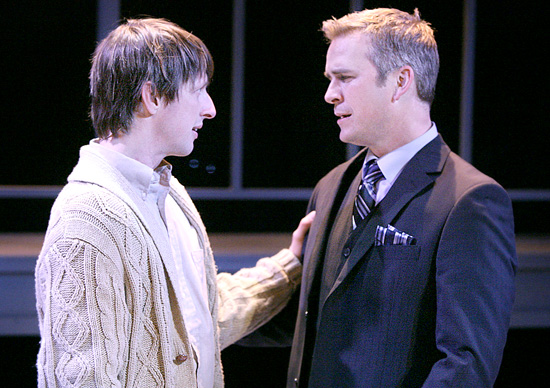
Thomas Weaver (Robert J. Townsend) is a best-selling short story author who is writing a eulogy for his one-time best friend from childhood, Alvin Kelby (Chad Borden), who has recently died.
The two actors carry the entire musical, and through them, the characters age from children to adults, all in the span of 90 minutes. The younger interpretations require a bit of suspension of disbelief, and the actors falter during that part of the play. But considering that there are no costume changes, it is understandable.
But when the characters grow into young men, the most powerful performances of the play come in.
Townsend plays Thomas with vigor; you believe and sympathize with his frustration and writer’s block. This writer surely did. His singing is strong and clear, paralleling Thomas’ role as the straight man in the friendship.
Borden complements him well as the gentler, more soft-spoken Alvin. His singing voice is weaker, yet he performs with such vulnerability that this imperfection suits the character.
The songs are sometimes dissonant, with the main tune of “Write What You Know” sounding quite similar to the songs in Stephen Sondheim’s “Sunday in the Park with George,” which is also a story about a struggling artist. As such, the melodies are not easy to sing, and it is a testament to the skill of the two actors that they can so effortlessly navigate through it.
Take “The Butterfly,” a particularly memorable song not because of its melody, but because of the story it tells, elevated by the music. The songs serve not as showstoppers, but to move the story along.
The stage setting is simple, merely two bookshelves and a balcony. But both actors occupy the stage so well, using every inch to convey different points and locations in their small town. After a while, you stop noticing the simplicity, and you are drawn into the story that is being told.
Yet the biggest flaw in the musical is that the friendship never seems authentic. These two people are so different ““ what brought them together, and what drove them to remain friends?
Toward the end, Thomas becomes so selfish and closed-minded that the audience is wondering why Alvin is holding on so tightly to him.
I had a hard time believing and investing in the friendship, which is detrimental when the play so strongly circles on these two men.
The saddest part about the musical is how unequal it is. The focus is so much on Thomas that the audience never knows about the real Alvin. All they see is a figment of Thomas’ memories, which any literature student will tell you is an inherently unreliable source of information. So who is the real Alvin? We never truly know, and as such, the musical feels unsatisfying.
Despite the imperfections, the ending is strangely peaceful. Some might find it too uplifting and unresolved. Yet that is the point. The audience is left with questions that are never answered because Thomas himself never knows the answers.
After all, there are certain parts of your life that you will never understand. The only thing you can do is concentrate on what you do know and to move on. That’s not a bad message to send.
It is a bit slow-moving at parts and is definitely not a musical for everyone. Yet for those with lasting memories of a childhood best friend, parts of “The Story of My Life” will resonate.
E-mail Tran at [email protected].