Red Darby never expected to be accepted to UCLA, especially as a transfer student coming from Columbia College. And not the Columbia in New York City, or the one in Chicago.
Darby’s Columbia is a small Northern California community college nestled in the Sierra Nevada Mountains, about 45 miles north of Yosemite National Park.
Darby applied to UCLA after receiving encouragement from their friends and advisors – and they got in.
“My face was shocked,” said Darby, a third-year sociology student. “A small-town person getting into here, what? Unheard of.”
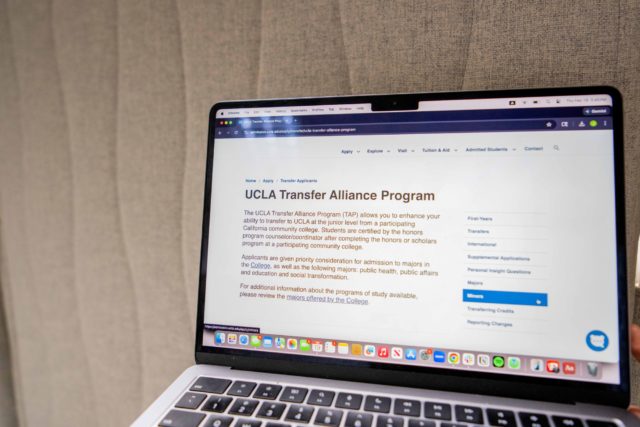
Darby said they found friends at Columbia College who supported their goals to transfer, but they also did not have access to UCLA’s Transfer Alliance Program. TAP – which consists of honors courses and specialized academic support at community colleges – aims to enhance students’ ability to transfer to UCLA.
Community colleges that are part of the TAP program boast high UCLA transfer admission rates, with some participating schools reaching an acceptance rate of more than 70% for TAP students.
About half of the California Community Colleges offer TAP programs, and many that do not are smaller rural colleges. Only two people from Darby’s community college were admitted as transfers to UCLA for fall 2025, according to admissions data.
Transfer students made up about 37% of the entering UCLA 2024-25 class, the highest of any campus across the UC, according to UCLA Newsroom.
Butte College, a community college located in California’s Central Valley, does not have the TAP program. But the college finds other ways to support prospective UC and UCLA transfer students, said Steve St. Cin, one of Butte College’s two transfer counselors.
St. Cin said Butte College provides application workshops, an on-campus transfer center, guest speaker events, four-year university tours and an annual transfer day featuring about 40 university representatives. The college had 36 UCLA transfer applicants for fall 2025 and a 33% acceptance rate, according to UCLA admissions data.
St. Cin also said Butte College provides a strong education and more individualized support compared to UC classes.
“They (Butte College professors) didn’t come here to publish,” said St. Cin, who has worked at Butte College for 25 years. “They didn’t come here to research. They came here to teach and our students love them.”
Hyerim Yoon, the Undergraduate Students Association Council’s transfer student representative, said she has worked to connect with prospective community college transfers from a range of backgrounds, including students from rural communities.
Yoon said she and her team compiled a list of contact information for representatives at all 116 California community colleges and reached out to them about several UCLA opportunities, including a transfer leadership fair and transfer panels.
Some of these events are virtual, which helps accommodate students who live far from UCLA, she added.
“We’re just going to show that an education at UCLA is possible and life at UCLA is possible, wherever you are currently,” Yoon said.
Darby said the idea of moving to a large city like Los Angeles felt daunting when they were first accepted. What convinced them to commit to UCLA, however, was attending a transfer experience held by Umoja, a program for Black students, where they met one of their now-closest friends, they added.
Darby is a part of the two-year McNair Research Scholars program at UCLA, which prepares students for doctoral programs. Darby’s research, they said, will examine rural community college students’ family, cultural and community support systems and how those factors shape students’ educational goals.
“I hope they understand that they are seen and it’s all good to be from a small town,” they said. “Props to them for making such a huge step.”
Alexander Salazar, a third-year psychology student who transferred to UCLA from Merced College, said he grew very connected to the community at Merced College, but also had to navigate a lot of the transfer process alone. Merced College had 55 students apply to transfer to UCLA for fall 2025 and 16% of them were accepted, according to UCLA admissions data.
While he was a student at Merced College, which is located in California’s Central Valley, Salazar served as student body president. He said he used his platform to advocate for expanded support for Hispanic students at the college.
Salazar plans to pursue graduate school and become a community college academic advisor to give back to his community, he added.
“It’s a lot easier to learn about yourself in community college and you’re going to feel really rewarded by going to the school you want to go to,” he said.

Comments are closed.