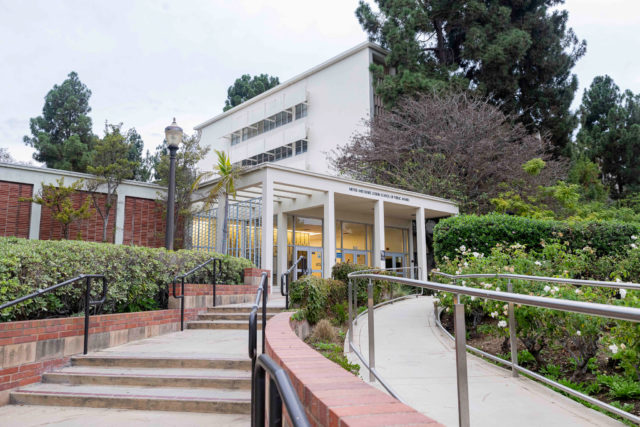
When third-year data theory student Madeleine Curran declared UCLA’s gerontology minor, advisors warned her that the required classes were rarely available.
After nearly two years in the program, Curran said the advisors were right.
“I did declare the minor spring of my freshman year, and it took until spring of my sophomore year before any gerontology classes were offered,” Curran said.
The gerontology minor – a minor in the UCLA Luskin School of Public Affairs that covers aging – offers 10 classes, including two psychology upper division courses. Of the other eight gerontology-listed courses, only three have been offered from fall 2024 to spring 2026, with none being offered more than twice.
Lené Levy-Storms, the director of the gerontology minor, said that the Luskin School currently offers the core course Gerontology M108 and another elective. The psychology department offers several other classes – but does not reserve spots for students in the gerontology minor, added Levy-Storms, who is also an associate professor of social welfare and medicine/geriatrics.
Mina Pham, a second-year biochemistry student who is considering the gerontology minor, said she worries about her ability to enroll in enough classes to finish the minor. Pham added that she believes more students would give the minor a chance if classes were regularly available.
“We need to really dedicate more time and effort into coordinating across the departments and working more to make sure that we make things available,” said Poco Kernsmith, a professor of social welfare and chair of the department.
Curran said the classes she has taken have mostly covered the sociological aspects of gerontology, which she has found to be interesting. However, she added that she believes the minor should include classes from other fields, like biology.
Michael Lens, the chair of the Luskin undergraduate programs and a professor of urban planning and public policy, said gerontology is a naturally interdisciplinary field. He added that he believes the minor could benefit from having specialists in different fields, such as economics or public health.
The Fielding School of Public health previously offered gerontology minor classes, Levy-Storms said, but many of the professors who taught those courses have retired or died and have yet to be replaced.
Kernsmith said the social welfare department has plans to hire someone with expertise in aging, but has faced some challenges due to UCLA’s hiring freeze. The university paused new faculty hiring in August following the suspension of federal research funding.
[Related: UCLA pauses new faculty hiring, will consolidate IT teams following funding cuts]
Levy-Storms added that she is also looking to recruit existing faculty to teach about aging.
“We’ve been looking at courses all over the campus, across all disciplines, and seeing if they have anything that is relevant to aging that, with a little extra work, could be emphasizing aging a bit more and potentially count as an elective,” Levy-Storms said.
Curran said the public affairs department newsletter also provides information each quarter on additional classes that can fulfill requirements for the minor. She added that one example was a health policy class where, if students geared their assignments toward gerontology, they could petition for the class to count as a gerontology elective, which Curran successfully did.
Curran said she only began receiving public affairs emails after formally declaring the minor, and that she was unaware prior to these emails that she could petition additional classes for the minor.
Elizabeth Gutierrez, a second-year pre-public health student interested in the gerontology minor, said she also wished UCLA posted more information on additional classes for the gerontology minor to prospective students.
“I would have declared it sooner to know about those resources, and I probably could have been working towards getting those classes already,” she said.
However, Lens said he believes overpublicizing the petitioning process would amount to unofficially revising the minor without going through proper procedures, including receiving faculty approval.
Levy-Storms added that she believes the department should formally add these classes to the minor if they are going to be offered regularly.
The gerontology minor also currently limits the pre-requisite class M108 to upperclassmen. Lens said opening the pre-requisite class to underclassmen is not something he has discussed with his team, but is a proposition he believes is worth exploring.
However, students who took Cluster 80: Frontiers in Human Aging as freshmen are exempt from taking M108, as completion of the cluster counts for the pre-requisite and one elective. Cluster courses are yearlong programs for freshmen to fulfill general education and Writing II requirements, with each one focusing on a different topic.
Levy-Storms added that she has explored allowing the aging cluster to count for the pre-requisite and two electives.
“I would say that having done the cluster does really help,” Curran said. “Had I started the gerontology minor from scratch, it would have been a little more challenging.”
Pham, who did not take the aging cluster, said she only discovered the minor while scrolling through the UCLA minors webpage. She added that she felt more students would be interested in the minor if it were better publicized.
Levy-Storms said she believes the program should only be publicized when the minor has the capacity to handle more students. There are currently 25 students in the minor, a number that has been steady for the past 15 years, she said.
She said she has worked closely with students to resolve difficulties in completing the minor, including by allowing students to enroll with her in a 199 research contract class – which partially fulfils the capstone requirements for the minor. Levy-Storms said her door is always open for students to complete a 199 course, adding that she provides students with data sets, a syllabus and weekly mentoring to aid them in completing a research study.
Levy-Storms added that she also walks students through how to complete the 195 internship contract course, another capstone requirement.
“I’ve always facilitated those internships because I have existing relationships with numerous agencies across Los Angeles that I know are willing to work with students already,” she said.
Curran said she found the minor coursework enjoyable and would recommend it to others.
“We tend to have a lot of intergenerational conflict and misunderstanding,” Curran said. “I was interested in doing the minor because I was interested in … seeing if we can bridge that gap and problem solve for everyone, together.”

Comments are closed.