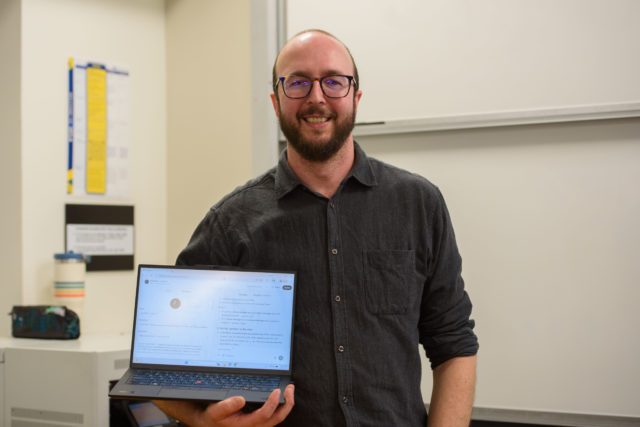
The department of statistics and data science has a new teaching aide – only, it isn’t human.
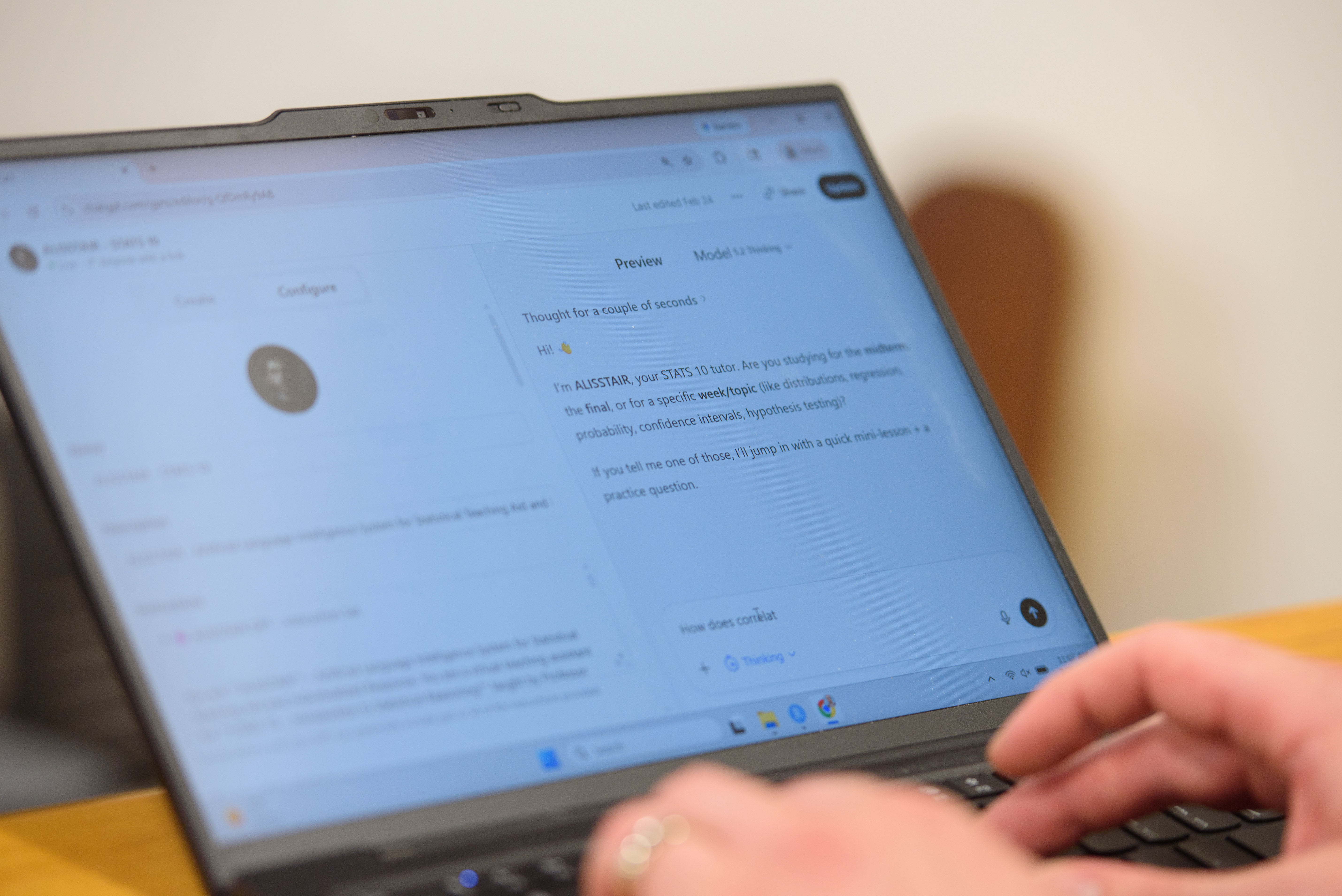
Thomas Maierhofer, a lecturer in the department of statistics and data science, developed an artificial intelligence teaching aide to use in his Statistics 10 and 20 classes. The AI TA, called Artificial Language Intelligence System for Statistical Teaching Aid and Individualized Response, or ALISSTAIR, can guide students through homework problems, reference specific lecture materials and walk them through the first steps of a solution without giving them the answer outright, Maierhofer said.
Maierhofer said he is currently requesting a two-year grant from UCLA’s Teaching and Learning Center so he can perfect ALISSTAIR and expand it to other UCLA departments in the STEM field.
“It’s specifically a teaching aid and not a teaching assistant,” Maierhofer said. “It’s not supposed to interfere with the TA’s role at all.”
The software has a ChatGPT base, Maierhofer added, but is trained on the course’s lecture slides, lab materials and syllabus – giving it the ability to provide tailored instruction to students.
But unlike ChatGPT, Maierhofer said, the AI does not automatically give students the answer. Rather, the tool tells students what materials they need to look through to figure out the problem, then gives them the answer after, he added.
Maierhofer has used the AI tool for two quarters in his Stats 10 class, he said, and for seven quarters in his Statistics 20 class.
Maierhofer said Isaiah Mireles, a fourth-year statistics and data science student, went to his office hours for help, and he told Maierhofer that he used ChatGPT to teach himself how to program with the coding language R.
Maierhofer said he was impressed with Mireles’ ability to harness ChatGPT to help him practice the skills taught in class and wanted to expand it to the rest of his students without encouraging academic dishonesty. He invited Mireles to collaborate on the creation of ALLISTAIR.
“Thomas believed in me and gave me the opportunity to really grow and develop this,” Mireles said.
Maierhofer said he sees the teaching aide as a substitute to Bruin Learn’s discussion forum because he believes students are often too shy to ask questions publicly. He added that it is difficult for him to respond to the forum immediately when students need help doing their homework.
Cooper Lee, a second-year applied mathematics and statistics and data science student, said he found ALISSTAIR easier to understand than the standard version of ChatGPT.
“ALISSTAIR is like being able to go to office hours and ask them (a professor) every single question you have without being held up by their availability,” said Lee, who took Statistics 20 with Maierhofer.
But ALISSTAIR is not meant to replace human teaching assistants, Maierhofer said. United Auto Workers Local 4811 – a union that includes UC teaching assistants – did not respond in time to a request for comment on the AI tool.
The department of mathematics reduced working hours for its TAs and eliminated all of its paid graders after UCLA cut its budget for the 2025-26 academic year. Stephen Agostini, UCLA’s former chief financial officer, told the Daily Bruin in a Feb. 6 interview that about 75% of academic units are running operational deficits.
[Related: UCLA math department TA, grader cuts spark concern over student learning, support]
Chancellor Julio Frenk announced Agostini was out as UCLA’s CFO days after The Bruin published an article in which he alleged that university administrators’ financial mismanagement led to the university’s $425 million deficit. Mary Osako, the vice chancellor for strategic communications, said in a Feb. 17 statement that Agostini overestimated the deficit but did not provide alternate data.
Even though it is not as answer-based as ChatGPT, ALISSTAIR still gives the student the answer in the end, said Bradley Tang, a TA for Maierhofer. Tang added that the software cannot replace a human TA who has been specifically trained to guide students.
“If we say it can be justified for cutting TAs, then at that point, the same kind of thinking can lead to saying, ‘Oh, do we even need instructors at all, universities at all to learn anything?’” Tang said. “That really goes down that rabbit hole.”
Tang added that human teaching assistants have empathy and understand the student experience because they were once students, too. He added that he believes they are objectively better at adding conceptual questions, while ALISSTAIR can assist with more technical ones.
Maierhofer added that AI is not able to conduct discussion sections and office hours. In addition, teaching assistants can figure out what students are asking when they do not phrase questions in a totally logical manner, he said.
Lee said he believes other classes should consider implementing AI tools that specifically focus on course content.
“ALISSTAIR is special in that it can really focus on this one thing and then give you help in that one thing,” Lee said. “That strategy for future AI and education is going to be helpful.”




Comments are closed.