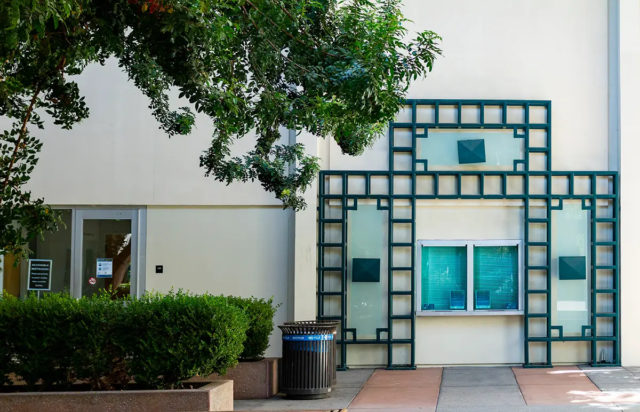
Over 3,000 students applied to UCLA’s School of Theater, Film & Television in 2025.
TFT offers undergraduate and graduate programs in film, television, digital media and theater. These programs are designed to introduce and prepare students for the realities of the entertainment industry.
UCLA first started offering drama classes under the English department in the College of Applied Arts in 1941. UCLA’s theater arts department was not officially established until six years later in 1947, when renowned producer Kenneth Macgowan took over as the first chair, according to TFT’s website. By 1960, under founding dean William Melnitz of the College of Fine Arts, the university successfully combined theater, film and radio into one unified academic program.
Over the following decades, the school broadened its curriculum to reflect industry changes, including teaching the growing influence of social media in the field. TFT recently launched its new Picture Start initiative, a series of extracurricular master classes teaching students about the new booming medium of microdramas, which are short, vertical soap operas designed to be watched on phones.
One of the department’s key strengths is its faculty with expertise across the industry.
Alex Franklin, a film lecturer at TFT, said the professors who work as active professionals in the entertainment industry make the school special.
“So many entertainment industry careers are a bit mysterious or even opaque in terms of what the day-to-day work is,” Franklin, who is also a talent manager at Zero Gravity, said. “What is it to be an agent, an executive, a producer, a manager and to work at large corporations like studios, networks, agencies, management companies.”
Franklin said his coursework aims to pull back this curtain, replacing industry myths with concrete operational knowledge.
“The goal is to teach students about how the business works, about how the large companies operate and interact with each other,” Franklin said. “What the different entry level jobs and career trajectories are within those companies, and how students can start their entertainment industry career.”
Kosi Eguchi, a third-year theater student, said the school’s curriculum mirrors the industry’s emphasis on networking and collaboration.
“A big part of TFT, and something that really makes me think that the school environment reflects the greater entertainment industry … is that it’s all about connections,” Eguchi said.
Eguchi also said faculty members are a key part of that experience, adding that many instructors bring professional insight beyond traditional classroom learning.
“These connections teach you, because they themselves are practitioners of their art,” Eguchi said. “They have insight and advice that goes past the classroom.”
For example, before moving to Zero Gravity, Franklin worked at Lionsgate Films alongside producer Peter Block on horror movies, including the “Saw” franchise.
Talar Kivork, the director of global brand partnerships at Warner Bros, said networking and establishing connections is an integral part of the industry.
“Network, network network.” Kivork said. “Never be afraid to send an email or a LinkedIn request, even if you have to send 100 and get 10 responses, those 10 responses are what is going to help you meet the next person or get the next opportunity.”
An actor’s professional network plays a significant role in career advancement, according to Backstage, a casting platform for performers. The site encourages aspiring actors to attend as many events where industry directors, writers and fellow actors are present.
Building networks to secure connections and job opportunities is especially important, as the performing arts field has historically seen higher rates of part-time employment and average salaries about $20,000 lower than those of all bachelor’s degree holders, according to the U.S. Bureau of Labor Statistics.
Beyond faculty relationships, Eguchi said TFT’s mentorship culture through its internal big-little program – pairing younger students with upperclassmen – is an effective way of establishing rapport and learning about new opportunities through peers.
UCLA TFT also partners with the Geffen Playhouse to provide undergraduates with a semester-long practicum centered on nonprofit theater management, according to the Geffen Playhouse website.
Throughout the course, students rotate through the Geffen’s artistic, production, development and education departments, completing specialized tasks alongside industry staff. This immersive experience concludes with a final group project where students pitch their own comprehensive plans for launching and marketing a non-profit theater.
Eguchi, however, said pursuing industry experience while managing academic expectations can be challenging. He said he finds it difficult to balance training to become a hirable actor while meeting classroom responsibilities, noting that breaking into an industry that prioritizes experience can be difficult when students are still expected to remain fully immersed in their studies.
Despite TFT’s extensive academic theater curricula, Eguchi said he also found value in partaking in student-led projects outside of the classroom.
Student-led organizations offer students hands-on experiences in the disciplines taught in the classroom.
For example, the Film and Photography Society provides a program offering students to produce their own films and gain experience working on a professional set.
Another student group, Act III Theater Ensemble provides opportunities for students to participate in productions centered around marginalized voices, highlighting LGBTQ+ performers in their productions.
[Related: Act III Theatre Ensemble discusses representing the queer experience on stage]
Eguchi said that many efforts to integrate the different departments within the TFT program are led by students, rather than driven by the school itself.
“There aren’t any classes or any relationships between the departments that the students are aware of in terms of faculty connections, or faculty pushing students to engage and create art together,” Eguchi said. “That’s a very student-driven thing.”
Despite the disconnect between the two departments, the faculty does its best to keep students updated on the recent shifts within the rapidly changing industry.
Franklin said looking ahead, the department is always finding new ways to teach students about evolving industry trends.
“Me and the other professors, or at least the ones I talked to, in my corner of TFT, are always trying to figure out what’s going on right now that our students need to know,” Franklin said.



Comments are closed.