

This post was updated May 27 at 9:29 p.m.
Warning: Spoilers ahead.
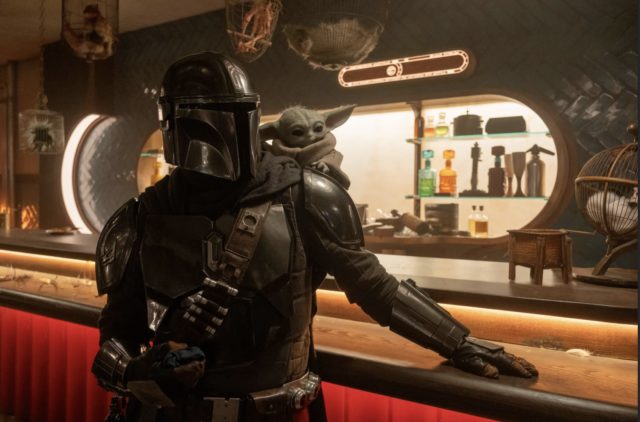
Sputtering into theaters by jetpack Friday, “Star Wars: The Mandalorian and Grogu” concluded Disney’s beloved “Mandalorian” franchise with an engine failure of a narrative.
Initially conceived as the fourth and final season of the series by showrunners Jon Favreau and Dave Filoni, the two opted to produce the season’s narrative as a feature-length film because of delays caused by the 2023 Writers Guild of America and Screen Actors Guild-American Federation of Television and Radio Artists strikes, according to Forbes. This decision, it seems, may have been a lethal falter that prevented the franchise from cementing itself as one of Disney’s finest after the 2019 conclusion of the decadeslong Skywalker saga.
“The Mandalorian and Grogu” follows the eponymous characters’ mission to hunt down remaining Imperial leaders after the fall of the Galactic Empire in a three-act structure, detouring into dark inner-city corridors and lush swamp planets. What begins as a mission to capture the elusive Imperial warlord Janu Coin (Jonny Coyne) soon leads the Mandalorian (Pedro Pascal) and his adopted child Grogu to the doorstep of the criminal Hutt clan. There, Hutt leaders offer the two information on the warlord’s whereabouts in exchange for rescuing their kidnapped kin Rotta the Hutt (Jeremy Allen White). The two then rescue an initially unwilling Rotta from his captor’s gladiator arena, where he reveals Coin as the true culprit, prompting the trio to forego the Hutts’ exchange and hunt down Coin themselves.
[Related: Winner takes all: The best, this ‘Star Wars’ movie is. After nearly 50 years, which film is on top?]
The literally towering figure in this first act is White’s Rotta – a rather unnerving casting choice for fans of “The Bear” – who is a misunderstood brute living in classic “Star Wars” villain Jabba’s shadow. Instead of further expanding the signature “Star Wars” theme of villain to hero, writers Favreau, Filoni and Noah Kloor pacify Rotta at the end of the act, reducing him to an otherwise uninteresting sidekick to the Mandalorian for the rest of the film.
The remaining two acts focus on the fallout that ensues after the Mandalorian fails to return Rotta to his family. Soon after returning home, the Mandalorian is abducted by a bounty hunter sent by the Hutts. Later, Grogu and a group of ship repair technicians save him and narrowly escape the clutches of the Hutt clan. At the end of the second act, the audience is given a reprieve from repetitive battle sequences through a Grogu-focused subplot, in which he must nurse a fatally poisoned Mandalorian back to health. Shortly after he wakes up, the duo jumps back into action, leading a rebel assault on the Hutt compound to save the recaptured Rotta. These final two acts suffer from plot exhaustion categorized by overdone capture-rescue structures, ultimately exhausting the classic “Star Wars” narrative formula.
From a narrative standpoint, Favreau, Filoni and Kloor would have benefited from considering the implications that come with adaptation, including what makes a television narrative particularly apt for film. Throughout the movie, one gets the impression they are watching a multi-episode narrative arc in the same vein as Filoni’s beloved “The Clone Wars” series, but with the narrative punch of decently crafted video game cutscenes. When one becomes too engrossed in shiny production toys – Favreau again uses Industrial Light & Magic’s pioneering StageCraft, an on-set virtual production system built around a massive video wall – they risk losing sight of the vital undercurrent that drives their production: the plot. Indeed, each of the film’s three acts is so clean-cut and low stakes in terms of contained narrative arc that the audience feels infantilized. The story never offers enough complexity to chew on for a two-hour runtime, a potential consequence of the short-form content era.
[Related: This costume designer dressed ‘Dune.’ She’s teaching UCLA students her craft.]
Historically, “Star Wars” films have been technologically innovative and thus rough around the edges. When George Lucas created the first fully CGI character in a live action film in “Star Wars: Episode I – The Phantom Menace,” he was met with harsh pans from critics. Many fans look forward to not only what “Star Wars” creatives get right with a new production but where their experimentation goes wrong – and what the franchise learns from that misstep.
With “The Mandalorian and Grogu,” Favreau seems to have ignored this basic tenet of the franchise’s cinematic identity, gutting any avenues for experimentation with a sterile color palette and clunky action scenes. Fight sequences no longer exhibit the lithe choreography of “Revenge of the Sith,” nor do the emotional climaxes carry the visual intensity of “Rogue One.” Behold Disney’s sci-fi output of the streaming age, which beguiles audiences with beloved intellectual property only to reveal technical creativity apt for a television special.
And on top of the film’s narrative floundering and lackluster visual direction, Favreau fails to deepen the widely adored bond between the Mandalorian and Grogu. For seven years and throughout three seasons, viewers have returned to “The Mandalorian” to watch the relationship between the aloof bounty hunter and his Force-sensitive son grow. With great emotional satisfaction, viewers witness a detached hunter become a tender father to an orphan against the fallout of a galactic war. Perhaps the only instance in which this is even highlighted occurs when a resourceful Grogu tends to the dying Mandalorian in the woods – a lazy stab at the student-becomes-teacher trope. It is a shame that “The Mandalorian and Grogu” largely neglects this core aspect of the franchise’s identity and instead preoccupies itself with porting an otherwise unfit narrative rhythm for the big screen.
Perhaps the only redemptive quality of the film is Ludwig Göransson’s versatile score. The three-time Academy Award-winning composer returns for the conclusion of the “Mandalorian” franchise after composing the first two seasons of the show. In “The Mandalorian and Grogu,” Göransson’s ear for weaving sound with environment shines, infusing the Mandalorian leitmotif’s mix of orchestral “Star Wars” elements, organic instruments and modern electronic production with the sounds of each planet. Synthwaves shimmer during urban criminal underworld chase scenes, while wind instruments twinkle as Grogu meditates in jungle environments. Favreau failed to bring the Mandalorian to the big screen, but Göransson has certainly made this disappointment more palatable.
In the end, not even Grogu’s Force-wielding heroism can free “The Mandalorian and Grogu” from its episodic formula.


Comments are closed.