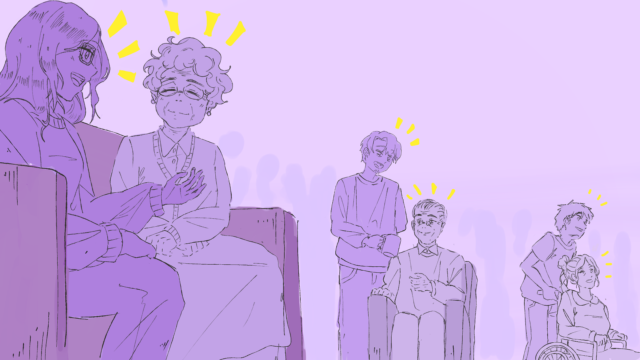
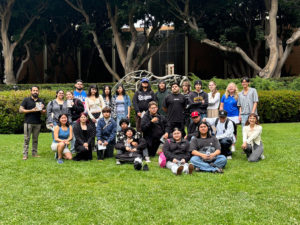
A UCLA club is partnering with local senior living homes and engaging in research to raise awareness about Alzheimer’s disease and dementia.
Brain-Health Education and Advocacy Movement at UCLA works with the Mary S. Easton Center for Alzheimer’s Research and Care at UCLA, which allows club members to learn from medical professionals and give back to the community, said Charlize Yip, BEAM’s current education director and incoming president.
Yip, a third-year physiological science student, added that BEAM allows students to shadow remote support groups for caregivers.
“A big part of healthcare is the caregivers who are involved, especially when it comes to Alzheimer’s and dementia,” she said. “It was always a really good experience to see the caregiver’s perspective, and then really understand what they’re going through and how – even though they don’t have the disease – they are heavily impacted.”
Caregiver support is especially important because more middle-aged adults are taking care of both their children and their parents, said Sofia Hollstein, BEAM’s current research chair and incoming education director.
BEAM is currently working on a caregiver research project in collaboration with the Easton Center, Yip said. The project will allow students to interview caregivers and bridge medical knowledge gaps between caregivers and doctors, she added.
The partnership with the Easton Center allows club members to serve as research assistants for the center’s principal investigators, as well as educate community members about Alzheimer’s and dementia at community events, Yip said.
BEAM also partners with Belmont Village Senior Living and Calligraphy Westwood Village, which are both senior living communities, said Iman Zuberi, the club’s current community outreach officer and incoming vice president. Zuberi, a third-year neuroscience student, added that students gave presentations on brain health to the communities and played memory-boosting games with the residents.
The club conducts brain health screenings at the senior centers and provides information about local resources to residents with memory concerns, Yip said.
“It was very unique how we are able to help – not diagnose but help recommend people to pursue an Alzheimer’s diagnosis or pursue a dementia diagnosis,” said Audrey Chiu, a general club member and the incoming publicity chair. “It’s really great that even though maybe I’m not a doctor or a physician, that I’m still able to help in some sort of way.”
Monica Moore, the community health program manager at the Easton Center, said she appreciates the club’s positive energy, adding that it encourages staff and faculty at the Easton Center to continue their work.
“We’re really helping to nurture and to be able to help create the new leaders of Alzheimer’s disease, dementia, aging, neuroscience,” she said. “We need more clinicians – we need more researchers, and the best way to ensure that you have a new workforce is to be able to support our students.”
Moore said she believes BEAM’s ability to raise awareness of Alzheimer’s among college students and the general population is important because many people do not understand the full scope of the disease.
Chiu, a first-year psychobiology student whose grandmother had dementia, said she joined BEAM to debunk misconceptions about the disease, which people often attribute to normal aging.
“It (Alzheimer’s) is not a normal part of aging,” Moore said. “This is a disease. There is a disease process that is happening, and some people need the support, and people need the care, and we need to discuss it.”
Yip said she believes people should learn about habits that can be adopted to lower the risk of dementia. For example, the club members often advise older adults to exercise and find a sense of community, she added.
Hollstein, a second-year human biology and society student, said while many of BEAM’s current members are pre-health, the club hopes to recruit more humanities students to explore different avenues like healthcare policy.
The club plans to host more educational events next academic year, including a seminar where students can teach older adults about brain health, Yip said.
“BEAM has a lot to offer in the sense that we’re still a newer club, so there’s a lot of room to help us improve and to really make an impact on the club now,” Zuberi said. “We really are trying to make sure we’re giving all of our members the best opportunities possible.”

Comments are closed.