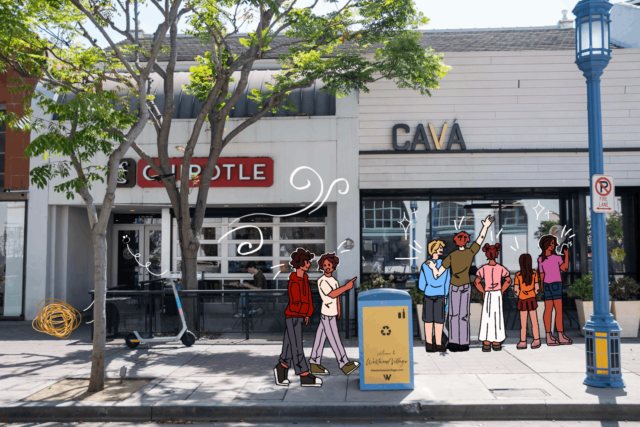
In 2026, Westwood can improve by making itself more appealing to businesses, expanding walkable areas and setting concrete goals, residents and experts said.
UCLA alumnus Grayson Peters said he sees Westwood’s unique mix as a residential neighborhood and college town as a challenge for new businesses, given that each stakeholder has competing needs.
“Westwood is, and has been in the last few decades, a very bifurcated neighborhood in that there is the campus community and there’s the noncampus community,” Peters said. “I still find it objectionable the extent to which there are interest groups in the Westwood neighborhood which do not fully see the university and students as full or worthy members of the community.”
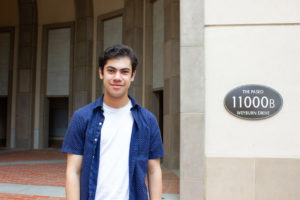
Peters served as a member of Westwood Forward, a group representing students and other temporary Westwood residents.
The coalition was created as an alternative to the Westwood Neighborhood Council – the certified advisory board to the City of Los Angeles City Council – with the goal of specifically advocating for the demands of UCLA students living in the area, Peters added.
Peters, who joined the coalition shortly after its 2017 founding, said the past WWNC did not fully represent the makeup of Westwood, as it failed to account for temporary residents, such as students. The group was formed in 2017, but has not been active since 2023, when the North Westwood Neighborhood Council’s student representative roles succeeded it.
Peters, while not a founding member, said he aided Westwood Forward’s efforts to fight for issues pertaining mostly to college students – including affordable housing, cost of living, transportation access and concerns regarding nightlife.
Anderson Strategy Group, a consulting group run by UCLA business students, said in a June 2025 report that the Westwood Village Improvement Association focuses too much on its student population and should instead appeal to families and improve vacancy issues.
[Related: Report urges Westwood Village to expand commercial appeal beyond students]
Property appeals have stalled business openings and discouraged new businesses from opening despite many residents supporting them, Peters said. Three community members submitted 61% of appeals – documents filed with the city addressing violations of local ordinance – against local businesses and properties from 1998 to 2019.
[Related: Document shows three people account for majority of property appeals in Westwood]
“The community broadly wanted a lot of improvements, wanted vitality, wanted businesses coming in and succeeding,” Peters said. “But the structures of getting government approvals were built such that a small interested minority of constituents were able to obstruct a lot of that from happening.”
Steven Sann, chair of the Westwood Community Council, and Josh Trifunovic, president of the North Westwood Community Neighborhood Council, did not respond in time to a request for comment on the appeals and their view on the future of Westwood.
Michael Manville, the chair of the UCLA Luskin School of Public Affairs Urban Planning department, said a disconnect between permanent residents and part-time residents has made it difficult to create change in downtown Westwood.
“The neighbors in Westwood were very opposed to the types of things that would inject a lot of life into the Village, and they had a lot of sway,” Manville said.
Manville also said he believes the structure of downtown Westwood – which includes four-lane streets – may inhibit its ability for growth as a walkable area.
“There was a concerted effort over the course of many decades to make it (Westwood) much more car-friendly,” Manville said. “And when you do that, one byproduct of that, that’s usually not intentional, is it becomes a slightly less appealing place to walk around and sit outside.”
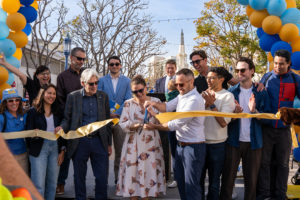
Expanding pedestrian access by limiting sidewalk roadblocks and improving street aesthetics could help Westwood stick out as both a walkable area and highlight its businesses. Broxton Plaza – a car-free area between Weyburn and Kinross avenues – opened in Westwood in February 2025.
Yet, for Greg Willsey, the CEO of craft sandwich shop Bread Head, coming to Westwood was a matter of looking to the future.
“There’s a Van Leeuwen that just opened, there’s Cane’s (Raising Cane’s Chicken Fingers) coming out,” Willsey said. “It’s going to restore the vibrancy of that downtown area, and I think it was nice to be a part of it.”
For students, ensuring Westwood has the best possible future can be a matter of supporting local businesses and not littering, said Jacob Lawson, a third-year architectural studies and public affairs student and an undergraduate student board member of the NWWNC.
“If we really think about this as our neighborhood and try to keep it clean, I think that goes a long way,” Lawson said. “We have such great businesses here, and making sure to walk down into the village and go and support them.”
The community’s goals need to be more succinct, Manville and Peters said.
“The playing field itself is malleable if students have the will and interest to change it,” Peters said.

Comments are closed.