This post was updated Aug. 9 at 11:20 a.m.
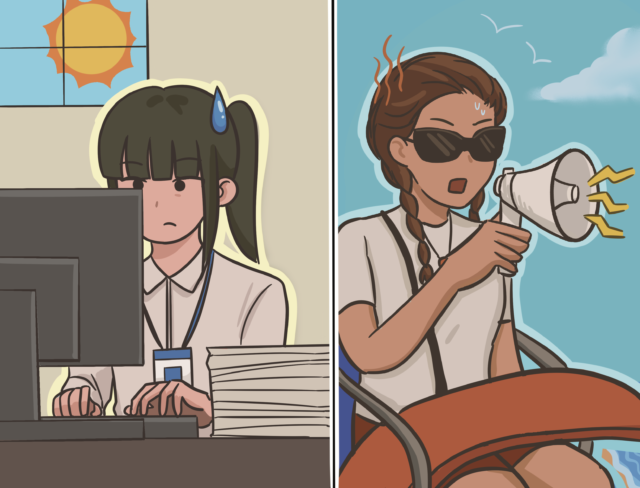
The smell of chlorine hits my nose before the water does, waking me up for my morning shift at the pool.
I’m a lifeguard in my hometown. It’s a great summer job – decent pay, friendly coworkers and tanning opportunities galore. However, I wasn’t planning on coming back to lifeguarding this summer. I was hoping to land an internship and start preparing for my career after college.
For many students, summer internships are a critical part of the undergraduate experience. But as summer approached, my goal of landing an internship seemed further and further away. I applied to all the opportunities I could find online and qualified for, but it felt like I was sending my resume into the deep. I often wouldn’t hear whether anyone even received my application. For the ones that did get back to me, it was an email with an all-too-familiar start – thanking me for my interest but acknowledging that it was a competitive year and, ultimately, rejecting me.
The process of getting an internship is daunting. Just take it from Andreu Beltran, a rising second-year public affairs and statistics and data science student, whose plans weren’t finalized until a few weeks before summer.
“I was kind of freaking out about that a little bit,” Beltran said. “The added pressures of everybody doing it – everybody wanting an internship at the college level – kind of makes it a necessity if you want to land a job later on or go to a graduate school.”
Without internships, it can be hard for students to get a sense of how to apply technical skills to the workforce.
UCLA, though, often leaves students without a life raft. By increasing the number of career resources available to students, UCLA can help students succeed post-graduation, internship or not.
Getting an internship is like swimming against a riptide. For me, an internship I hoped to land had an unexpectedly large number of candidates, leading the company to add more prerequisites to the application – ones I didn’t have.
Internship opportunities went down by 16% on Handshake – a job application platform used by undergraduates and by UCLA until earlier this month – in early 2026, and internship applications to jobs posted on Handshake during the 2024-25 academic year were more than double what they were in 2023 on average, according to the Wall Street Journal.
Ginger McIntosh-Taheri, a rising second-year pre-public health student, said the company running her summer internship canceled the project she was hired for in June. Afterward, most application windows were closed, and she’s hoping to land an internship next year instead, she added.
“We do have lab classes, but it’s not the same as doing research with a company or doing clinical research,” McIntosh-Taheri said. “With an internship, I was looking for something that would allow me to just increase my knowledge and understanding of the medical field.”
While the Career Center does a lot to help students find possible opportunities, UCLA is a huge school. When specific academic departments make a greater effort to connect students with internships, career readiness doesn’t have to feel like an upstream battle.
My own internship hunt ended when I found a position for the upcoming academic year through Annie Carpenter, the Art History department’s advisor.
I felt like I could finally come up for air.
Having a specific internship available through my department made the process much easier and felt less competitive, and UCLA should make an intentional effort to offer more opportunities like it.
Part of the problem is making sure students are aware of their resources.
Ensuring that students are informed about opportunities like the alumni network, departmental advisors and the Center for Community Engagement – which runs most internships for academic credit – is the first step toward improving student engagement.
“Finding ways to engage with students in a way that will resonate is important, especially as the simplest way for us to connect with students, through email lists, can often mean messages get buried in student inboxes,” Carpenter said in an emailed statement.
Students should not feel like they’re drowning in pressure just to feel career-ready. Even as a lifeguard, I can’t save anyone from drowning under the pressure of not feeling career-ready. But more career-focused resources from UCLA could help.



Comments are closed.