Sources: California Environmental Protection Agency CalHeatScore data and Los Angeles County ZIP Codes. Graphic reporting by Charlie Hamilton, Science and Health editor. Interactive by Bianca Peralta, Data editor.
As temperatures soar in Los Angeles, UCLA experts and local government agencies are working to help residents stay cool this summer.
The Los Angeles Regional Collaborative for Climate Action and Sustainability – a network of local governments, agencies, organizations and academics – created the Extreme Heat Campaign in 2024, which aims to educate people on extreme heat safety and heat-related illness prevention through outreach, according to its website.
“The main thing is being knowledgeable and aware – and knowing that it’s a dangerous thing and not just a hot day,” said Lauren Dunlap, a project manager for the UCLA Luskin Center for Innovation.
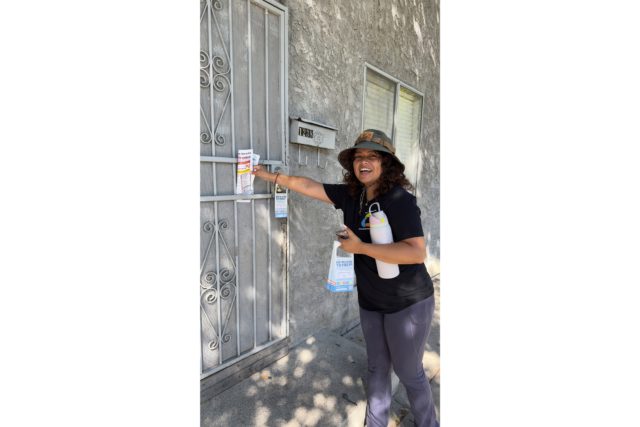
Community healthcare workers trained by LARC, also called heat ambassadors, distribute resources including flyers, fans, water bottles, sunscreen and Metro TAP cards to residents during a 30-month-long project, according to the organization’s website. The project is supported by a $3 million grant from the California Governor’s Office of Land Use and Climate Innovation.
Extreme heat is the deadliest weather-related risk in LA County and has led to an average of 898 emergency room visits a year, according to the LA County Department of Public Health. The National Weather Service issued a heat advisory in LA County in July, with temperatures ranging between 88 and 96 degrees.
Heat ambassadors have helped people realize how they have previously been affected by heat-related illness, said Ellen Ma, the program’s campaign and communications coordinator.
The campaign is focused on uplifting communities at high risk of heat-related illness, such as older adults, children, people with disabilities and people experiencing homelessness, Ma said. She added that these groups tend to have less access to ways to cool down from extreme heat.
“It is very easy to develop a heat-related illness, and people aren’t aware about how quickly it happens,” Ma said.
Volunteers distributed about 20,049 flyers, 1,398 sunscreens, 9,901 door hangers and 1,833 printed fans last year, according to the LARC-HEAT 2025 Evaluation Report.
The initiative is looking to expand outreach efforts this year by implementing feedback and reframing the program’s marketing to ensure all vulnerable groups get the information they need, said Erin Coutts, the program’s executive director, in an emailed statement.
While communication campaigns can be a challenge, they are crucial in bringing awareness to heat-related illnesses, Dunlap said.
Dunlap, who led research on public information campaigns related to heat risk, said the climate action program incorporated her findings to develop the campaign.
Her research included guidance on communicating heat risk through tailored information on graphics, posting social media content year-round and creating formal evaluations through interviews and data collection. Dunlap added that she interviewed people across the country who experienced extreme heat conditions for her research.
Ma said it’s been rewarding to build relationships with the UCLA Institute of the Environment and Sustainability – which provides logistical support to LARC – and researchers, who have helped with outreach field work.
“We are out in the field working with community members,” Ma said. “They (IoES) love having us here because of that. It provides an edge to their work that some of the researchers may not be as engaged in.”
The campaign has improved community health worker training, translated its graphics to Spanish and distributed a greater variety of educational materials, Coutts said in the statement. She added that similar campaigns can be implemented outside of LA to help more communities combat extreme heat.
“While Los Angeles County remains one of the most populated regions and has a long history of extreme heat issues, no region is immune to the heat,” Coutts said in the statement. ”With our resources and public awareness efforts published online, we hope that the LARC extreme heat campaign can be replicated in other regions.”


Comments are closed.