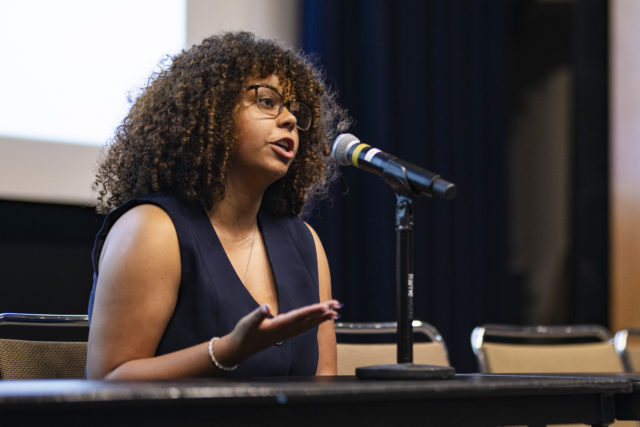
Undergraduate Students Association Council President Jayha Buhs Jackson is focused on increasing transparency and making campus resources accessible for students.
Jackson, a rising third-year African American studies and public affairs student, spoke with campus politics editor Nicholas Mouchawar about her plans as president and the issues she believes students should be aware of. She was previously a USAC general representative during the 2025-26 academic year.
This interview has been edited for length and clarity.
Daily Bruin: For Bruins who may be unfamiliar with student government, what is USAC, and how does its work affect their everyday experience at UCLA?
Jayha Buhs Jackson: Fifteen of us are elected every spring quarter to represent the undergraduate student body. That consists of our executive cabinet, president, internal vice president and external vice president. We also have three general representatives.
The main thing that I want new Bruins to understand is we have a budget of $10 million in student fees. They have full right to comment on how those student fees are being used.
But there’s also a significant amount that goes to pay each of the USAC officers, that goes to pay our election board and that goes to pay our judicial board, which are known as USAC entities. We are their overseers, and those are other opportunities for students to apply and be appointed to. A lot of the additional funding goes to funding under USAC that students are able to apply through their participation with student organizations.
DB: Looking back on both the successes and challenges of the previous council’s term, what lessons are you bringing into your presidency?
JBJ: I was really hopeful about intentional USAC bonding within our officers. It was important we all established great working relationships. We are all students, but we are also all going to be on council together for this year. Those cordial working relationships will be very important in co-facilitating programming.
A common reoccurring issue was people not knowing who these officers are. I was most concerned when I saw people running for positions and not knowing who their possible predecessors would be, and I feel like that was a huge failure on our part, not doing general promotion of who USAC is. We’ll be doing a lot of new student orientation programming. It’s very important people know who the reps are because they could be helpful in so many ways.
There was no enforcer of the bylaws, and the president is supposed to be doing that because they have full executive power and have to carry all those things out. It’s very important that the president, as the chair, is enforcing those meetings.
[Related: 2026 USAC resolutions call for accountability, student support but see few updates]
DB: What are your office’s main priorities for the upcoming academic year?
JBJ: Something I really want to be doing is greater promotion of the student impacts that are happening and what’s actually going on in these committee meetings.
Something else I’m trying to do is letting students come to meetings with me with the “Seat at the Table” initiative. I’ve been able to regularly meet with all these different organizations less familiar with USAC, getting to know about USAC’s resources, funding and how USAC works.
It’s very important that USAC uses its standing to pull in student resources, especially if students feel like they’re not being adequately met by the university. We have a lot of students who are Pell Grant and Cal Grant recipients. We want to be attuned to students who have a variety of socioeconomic statuses.
Another thing I’ll be working on as I’m hiring my fellowship director is revitalizing our USAC fellowship. It’s good teaching our fellows about USAC, but I want to give them skills that would be tangible in real life – something that is actually going to be supportive of them on their resume and having me as a reference. I was hoping to use it as an opportunity to match them with these community partners I’m making within UCLA and Los Angeles organizations, to match them into those internship opportunities through the fellowship.
DB: What issues facing UCLA students do you think students should be most aware of? How is USAC working to address these?
JBJ: Cost. Last year, the cohort tuition model increased, and then we saw Bruin One Access increase by ASUCLA. This was not communicated to me. There was no formal communication even to our own representatives. We had so many students who were like, “This was already a dent in my pocket, and now you want to increase it.” We’re seeing UCLA just steadily keep increasing these things.
[Related: Amid student concerns, Bruin One Access to increase to $149 per quarter]
DB: What advice would you give incoming students as they begin their time at UCLA?
JBJ: One, please go explore LA. Get out of the Westwood bubble. You will thank yourself so much later. Do LA public transit. Go outside. Touch grass.
Two, if you get a B, it will be fine. It’s not the end of the world. Your GPA will go a little lower, but it’s fine. You can get it up. You have time. You’re only a freshman.
Three, if you don’t want to get involved and you just want to take it easy, and you’re coming from a semester system and have to get used to this quarter system, that’s fine. But don’t let fear scare you from getting involved. Don’t let other people tell you, “It’s super competitive.” Just apply. If you want to do something, just do it. You’ll thank yourself for it.
Four, don’t be afraid to change your major. I got into UCLA as a biology major. I went to an organizing conference hosted by the UC Student Association, which I would later be a board member for that same year. I realized that wasn’t for me, and I had a better calling. I was undeclared for a bit, then was political science. I did that, then became African American studies, and then was pre-public affairs and completely switched paths. Now I’m applying to law school.
Do not be afraid if your path leads you somewhere else that you didn’t expect. I really wanted to be a pediatric surgeon. I thought that was the best way I could help my community, and now I’m doing that in a different way through advocacy, policy and law. Don’t be afraid to make those changes. You’ll be surprised by how much better you’ll be at where that path is leading you.


Comments are closed.