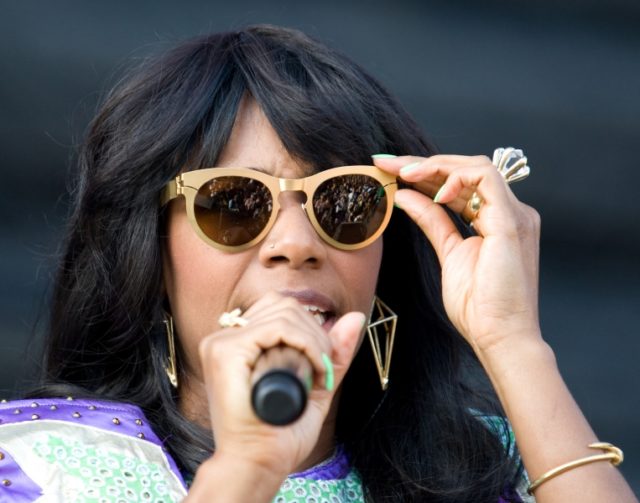
Santigold has spent nearly two decades refusing to be boxed into a specific sound.
The genre-defying singer, songwriter and producer is set to take the Dandelion stage at Daisy Chain Fields on Saturday The artist’s 2008 debut “Santogold” established her as one of the era’s most restless musical shapeshifters, weaving together new wave, dancehall, punk and pop. Since the release of her self-titled album, Santigold has released three more studio albums while lending her voice to projects ranging from soundtrack appearances on films “Paper Towns” and “Hunger Games: Catching Fire” to features on the Beastie Boys and A$AP Rocky tracks. The artist has been lauded for smuggling sharp social and political commentary into hooks danceable enough for the mainstream, even receiving a shout-out on Beyoncé’s “Break My Soul (The Queen’s Remix).”
Ahead of her performance at the inaugural music festival, Santigold spoke with the Daily Bruin’s Alexis Coffee about breaking genre boundaries, the power of collective performance and her hopes for the next generation of female artists.
This interview has been edited for length and clarity.
Daily Bruin: Daisy Chains is Saturday. How are you feeling?
Santigold: I’m really happy that it came together. I had spoken to Olivia early on when it was an idea, and I’m so impressed with the fact that she had so much drive and commitment to pulling it together. As a woman in the music business, you spend so much time around men all the time that it’s a really cool and special opportunity to be with so many women and even more for a cause that’s focused on getting women and girls the rights and the care that we deserve and need.
DB: You grew up in scenes like punk, new wave, early 2000s, where you were often the only woman in the room. How does that feel walking into a lineup that is the opposite of that?
SG: I don’t think I’ve ever done a festival that’s all women ever, if I’m not mistaken. So that’s a really special environment that she’s created and powerful. I was speaking to a couple guys in a meeting where I was the only woman in the room again, and they were like, “Oh yeah, maybe I’ll come to that.” Like what? I don’t get it. They said they were joking, but at the same time, I hope that other men don’t feel like they can’t support women because that’s insane. It’s really important that people understand that by supporting women, they’re supporting humanity. That’s a really important distinction that all these men running the government don’t get. If you don’t support women, you don’t support humans. But I don’t think they’re interested in supporting humans anyway. They’re interested in supporting corporations.
DB: Many artists who are a part of Saturday’s lineup, like Doechii and Chappell Roan, have cited genre blending and boundary pushing artists, like yourself, as influences. Do you see that when you’re watching them? Do you feel that lineage?
SG: At the time that I started, it (bending genres) was pretty much unheard of. They’d be like, “What genre are you?” And you’d be like, “Not one” and they just don’t get it. It was a really hard road to pave at the time, and I’m really happy that I stuck to it because I see that it (the music industry) has opened up. That’s better for music, but it’s also better for people. It’s better for artists to not have to fit in these tiny little boxes that other people dictate. It’s really important to be able to be yourself the exact way that you see fit. Artists are our leaders, who always have always wanted to follow that call. I’m very happy to be a pioneer of breaking down genres.
DB: All the proceeds go to nonprofits for girls and women. Was there a specific woman who made an impact on you, kind of early in your career?
SG: There’s so many. People like Grace Jones, Nina Simone and Chrissie Hynde. Just women who were kind of stepping into genres and energies that felt more rough. The reggae women, the dance hall women, all the women who were just tough and grimy and still feminine and rude and not scared.
DB: You’ve pushed “Spirituals” beyond the album into a tea and a podcast. What inspired you to choose to expand like that?
SG: I wanted it to be multisensory. Everyone wants to have it be “Oh, you’re a musician, and that’s what you are,” but no, I’m an artist, and so I like creating things across the board. Music is such a sensual experience. It’s not just with your ears or eyes. It’s the entire body. It’s vibrational. The podcast sort of mirrored some of the themes on the record and the tea ingredients were all in line with different emotional and physical needs. It was really cool, and it went with supporting all the stuff I was talking about on the record too. So it was just fun to take it out and branch it out across different mediums.
[Related: Q&A: Faouzia talks ‘FILM NOIR’ era, onstage world-building]
DB: You’ve said the album’s themes on “Spirituals” are about grappling with real time crises, while still making something danceable and fun. How do you decide what needs to hit hard and what needs to just move a crowd?
SG: I don’t think you have to choose. The trick is to get some deep messages into something that feels very digestible. It’s like taking medicine with honey or with comedy when you put some really hard issues in and get people laughing. It just makes it easier to process and metabolize. With music, I’m attracted to always pushing boundaries but still sounding very pop like and singable melodies. But I always want to talk about stuff that is really on my heart.
DB: If a young girl in this crowd Saturday walks away wanting to start a band or be a singer, what’s the one thing you’d want her to take away from watching you perform?
SG: Do what’s in your heart. You have to work in this business, and it’s not going to be quick and easy. Because the arts are in such a sad state economically and unsupported, it’s even harder than it ever was. It’s not harder to get in anymore because everybody can do it. But that makes it harder because there’s so much noise, and it’s so hard to actually impact. I would encourage artists to be more entrepreneurial than ever and to figure out a way to create income in the beginning that’s separate from the art but doesn’t take up all your time so that you can do your art. I believe if you really believe in something, you can make it happen. Be original and don’t just try to do what everyone does. Be in it for the right reasons because it brings joy to you and not because you want to be famous or you want money. The reason should be because of the love, and whatever you choose should be because you love it.


Comments are closed.