The Hill will trade Bruins for Olympians and Paralympians in 2028.
With the 2028 Summer Olympics approaching and becoming the center of many policy and infrastructure discussions around Los Angeles, UCLA’s planning for its involvement in the Games has kicked off.
The campus and dorms, which tens of thousands of students, faculty and staff pass through during the year, will be transformed into the Olympic and Paralympic Village – where Olympians and Paralympians live and practice during the global sporting event.
UCLA expects to support around 17,000 athletes, as well as members of their support teams, at the village’s peak, Administrative Vice Chancellor Michael Beck said.
“We’ll be housing them,” Beck said. “We’ll be supporting, feeding them. We’ll be a training center for many of the athletes and their events, and there’ll also be social activities that the Olympians are able to participate in.”
Chansoth Hill, the senior director for the Olympic and Paralympic Village under the UCLA Events Office – a role set to continue through December 2028 – said the university is working with the LA28 Organizing Committee to coordinate the campus transformation, which will range from dorm renovations ahead of the Games to alternative student housing during the Olympics.
All residence halls on the Hill and Weyburn Terrace will be used as housing, Beck said, adding that many campus recreation and athletic facilities – including the John Wooden Center, which has been undergoing renovations since early 2025, Drake Stadium, Sunset Canyon Recreation Center and Wilson Plaza – will be used by the athletes. The Arthur Ashe Student Health and Wellness Center will also serve as a medical hub for athletes.
Beck said UCLA is making accessibility renovations to several residence halls, which will be completed next summer. The changes are intended in part to accommodate the large number of Paralympians who will live in and travel through campus, he said.
Triple-occupancy dorms will also be converted into doubles for athletes and then converted back into triples before students return for fall quarter – with fall 2028 instruction set to begin about a week later than is typical.
For students staying at UCLA during summer 2028, the Games will change where they live and eat.
While university housing will remain available to students, they will be housed in University North apartments rather than the residence halls, and UCLA does not plan to offer student meal plans that summer because campus dining facilities will be providing 24-hour food service for athletes.
Beck said classrooms, research laboratories and other spaces used for academic programs are expected to remain available during summer 2028. He added that there could be reduced access to the Intramural Field and some parking challenges for the campus community.
Students also have opportunities to assist in the university’s support of the Games.
“For students in particular that want to volunteer for the Games, we have a unique opportunity for students that are 18 years or older to be able to volunteer in the Olympic Village,” Beck said. “As a result of the additional services that’ll need to be provided in the summer, there will be substantial student employment opportunities.”
Although many of the planned changes to campus will occur closer to the Games, Hill said students will begin seeing visible changes during spring 2028. Some modifications are already underway, and others will continue during summer 2027, while LA28 branding and temporary additions – which organizers refer to as “overlay” – will become especially visible around June 2028.
“You’ll start seeing changes occurring in the spring of 2028,” Hill said. “That’s when it’s becoming real that we will be the Olympic and Paralympic Village.”
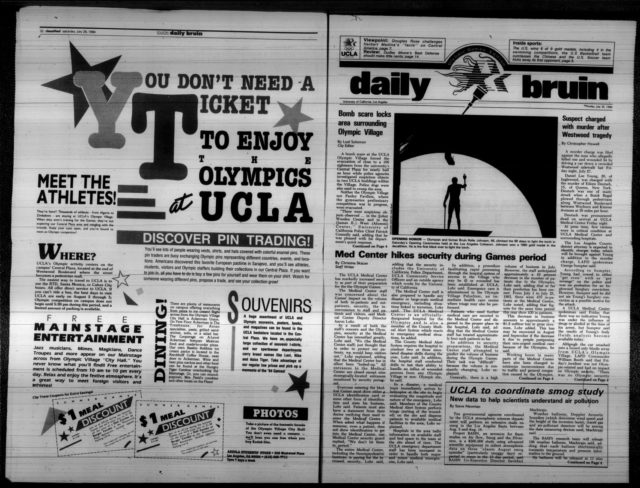
LA28 will not be UCLA’s first time serving as a hub for thousands of Olympians – the university also housed athletes during the 1984 Summer Olympics.
UCLA officials reviewed documents and an after-action report from the 1984 Games and met with people who were at UCLA during those Games while planning for 2028, Beck said.
However, Beck said the 2028 village will operate in a substantially different campus environment. UCLA now has significantly more housing and will provide more athlete training facilities than it did in 1984, he said.
The biggest difference was that UCLA’s facilities, including Pauley Pavilion, were used as official competition venues in the 1984 Games.
Beck said the university will hold its first Olympic Village town hall in October and continue the meetings quarterly, giving members of the campus community opportunities to receive updates and ask questions. UCLA also plans to launch a dedicated website this fall with regularly updated information for students, faculty, staff and visitors.
Yet, besides transforming UCLA into a village for thousands of athletes, the Games present another challenge beyond campus: moving athletes, spectators, workers and officials across LA.
LA28 organizers have described the event as a “transit-first” Games, meaning spectators will be encouraged to rely on public transportation to reach venues, according to LAist. LA Metro estimates the Games could generate around 1 million additional transit trips per day, nearly doubling the number of trips typically taken on a summer weekday, said Juan Matute, the deputy director of the UCLA Institute of Transportation Studies.
“The biggest challenge is hosting the 2028 Games on top of the existing transportation challenges,” Matute said. “So it’s additive rather than necessarily displacing anything.”
Part of the “transit-first” approach stems from security requirements around Olympic venues. Matute said secure perimeters established around venues will severely limit which vehicles can enter, making traditional venue parking impractical. At UCLA, athletes and coaches will be able to board buses that have already undergone security inspection inside the village before traveling to competition venues, he said.
LA Metro’s plan consequently relies on supplemental buses and mobility hubs that connect passengers from existing rail and transit lines to Olympic venues, according to its website. Matute said he believes the system could work effectively if buses are able to avoid congestion near venues.
“The challenge is going to be when the buses get stuck in traffic congestion, which happens every day in LA already,” Matute said.
LA underwent a smaller-scale test of its event transportation system during the 2026 FIFA World Cup, when eight matches were hosted at SoFi Stadium. Matute said the tournament gave local governments, transit agencies and event organizers experience coordinating operations and helping international visitors navigate the system.
The Olympic Games, however, will operate on a much larger scale.
Matute said he believes Westwood will be part of this increased activity, as the Olympic Village will draw in thousands of competitors and staffers over the summer. Matute said athletes will be able to leave the village when they are not training or competing, and he expects nearby businesses, hotels and public spaces to draw in athletes and visitors throughout the summer.
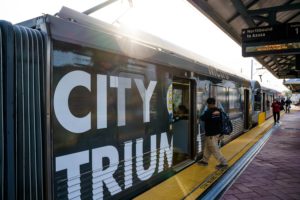
One major transportation change near UCLA is expected to arrive before that activity begins. The D Line Subway Extension’s Westwood/UCLA section – which would connect Westwood to downtown LA – is set to take its first riders in fall 2027.
The Olympics did not serve as the original purpose of LA’s major transit projects, Matute said, but it did prompt the acceleration of some planned developments. The D Line extension to Westwood is one project that likely would not open as quickly without the 2028 deadline, he added.
For Matute, some of the most meaningful long-term improvements may come not from new rail construction but from making existing public transportation more reliable. He said dedicated bus lanes, which the Olympics will push development for, can reduce the unpredictability caused by traffic congestion, allowing riders to know more consistently how long a trip will take.
“That consistency is what people build habits around,” Matute said. “What you want is people to build habits of using public transportation.”
Accessibility will also shape transportation preparations as LA prepares to host its first Paralympic Games. The Institute of Transportation Studies has highlighted sidewalk conditions and universal design as major concerns ahead of 2028.
Matute said damaged sidewalks and fragmented responsibility for them across LA agencies can limit independent travel for wheelchair users and people with other mobility needs, with different agencies responsible for sidewalks, curbs, streets and other parts of the public right of way.
While the Olympic and Paralympic Games will last only weeks, officials have repeatedly presented transportation improvements as part of a longer-term legacy for LA.
For Matute, whether that legacy succeeds will depend partly on whether temporary priority given to public transportation survives after the Games, he said.
“My requirement for a successful legacy is permanent lanes for transit, high-occupancy vehicles on surface streets that are currently frequently congested and will continue to be frequently congested in the future,” Matute said.
Beyond transportation, Beck said UCLA sees its role in the Games as an opportunity to demonstrate the university’s capabilities on an international stage and strengthen its relationship with LA.
“It’s such a great opportunity for the university to demonstrate the quality of the program and services that we can provide on a world stage for the world’s most significant athletic competition,” Beck said. “It demonstrates UCLA’s commitment and capabilities toward the city of Los Angeles and ultimately to the world.”

Comments are closed.