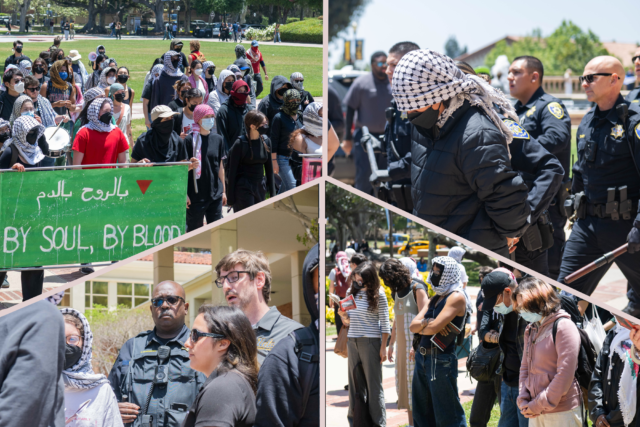
UCLA will add full-time positions to its Student Affairs Mitigation Program to support the university’s response to protests and other demonstrations, UCLA Student Affairs said.
The new positions include a full-time Manager of Student Affairs Mitigation and at least one full-time Student Affairs Mitigation Advisor, who will report to the manager. The positions are expected to be posted within the next two months, a UCLA Student Affairs spokesperson said in an emailed statement.
The new hires will work to enforce Time, Place and Manner policies. UCLA enacted the policies – which define rules surrounding public expression – in September 2024, following a slew of encampments and other pro-Palestine protests held the previous spring.
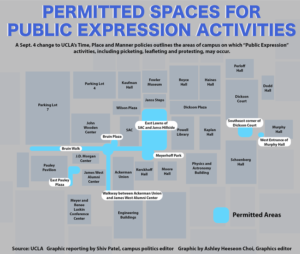
The TPM guidelines restrict demonstrations that are not approved by the university beforehand to “areas for free expression” – including Bruin Plaza, Meyerhoff Park and East Pauley Plaza – and ban them outright between midnight and 6 a.m.
[Related: UCLA’s finalized Time, Place and Manner policy alters public expression guidelines]
The SAM Program currently has eight staff members, including a manager and seven UCLA staff members who support mitigation efforts as part of their broader university responsibilities.
These Student Affairs Mitigators, who regularly observe on-campus protests, have clashed with demonstrators by instructing them to relocate to free expression zones or eliminate their use of amplified sound, in line with the TPM policies.
Steve Lurie, the associate vice chancellor for campus and community safety, said in a text message that Student Affairs Mitigators’ de-escalation tactics often help resolve a situation without involving law enforcement.
The Student Affairs spokesperson said Student Affairs Mitigators document interactions and responses at events. They added that the SAM Program maintains those records and shares them with appropriate campus partners for review. The spokesperson did not specify which partners. The records are retained for five years under UC records retention policy, the spokesperson said.
Student Affairs Mitigators do not determine whether a Student Conduct case is initiated, but information they document may be referred to the appropriate university office for review, they added.
Undergraduate Students Association Council President Jayha Buhs Jackson and Internal Vice President Gabrielle Trujillo said in an interview that the new positions could increase UCLA’s monitoring of protesters and enforcement of TPM policies. USAC has previously opposed UCLA’s TPM restrictions, unanimously passing a resolution in October 2024 that claimed the interim policies gave administrators excessive power to restrict student protest.
[Related: USAC passes resolution criticizing UCLA’s revised Time, Place and Manner policies]
UCLA policy allows Student Affairs Mitigators to request identification when necessary to determine a person’s affiliation with UCLA and direct participants to relocate, lower their volume or stop disruptive activity. Noncompliance can result in documentation and referral to Student Conduct through UCLA’s tiered response system, according to Mick Deluca, UCLA’s associate vice chancellor for campus life at an October 2024 town hall.
“It’s going to be a lot of enforcers of TPM, which can be very scary,” Trujillo said.
If participants continue the activity, a Student Affairs Mitigator may move the incident through UCLA’s tiered response system, the third tier of which results in UCPD involvement. UCLA has said the system’s third tier is reserved for imminent safety threats and criminal activity.
Student Affairs Mitigators may also contact UCPD for assistance, consultation or coordination when warranted, the spokesperson said. UCPD enforces applicable law but may also respond to potential university policy violations by providing assistance, consultation or coordination, they added. The spokesperson said law enforcement generally would not be the first response to a policy violation alone.
Buhs Jackson said administrators have explained how the response system is intended to operate but have not clarified why enforcement varies across demonstrations, which she believes reflects inconsistent application of the system.
“When I ask them about these questions, they’ll explain the tiered response very thoroughly,” Buhs Jackson said. “But then it gets tricky when I ask them about specific situations.”
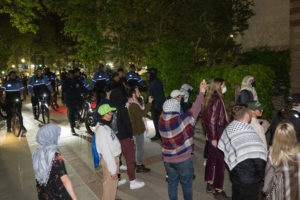
Trujillo said she believes UCLA’s tiered response system led to a disproportionate response during a May Nakba Day demonstration, which recognized the mass displacement of Palestinians in 1948. UCPD officers arrived in riot gear at the protest, she added.
“People are doing these really non-harmful, non-aggressive, non-violent forms of protesting that end up with a horde of UCPD officers,” she said.
[Related: UCPD detains demonstrator in pro-Palestine protest for Nakba Day]
Hiring more Student Affairs Mitigators could make it easier to collect information on demonstrators, Buhs Jackson said. She alleged that she has seen information gathered by current Student Affairs Mitigators – including students’ names – used in Student Conduct proceedings without students knowing how it was collected.
“I don’t think they should be able to take student data that can hinder them,” Buhs Jackson said. “That is incredibly harmful.”
Trujillo said UCLA should invest in de-escalation training that would prepare students to resolve conflicts without involving police.
“Students should still feel like they have someone advocating for them and they have someone in their corner,” she said. “This actually isn’t keeping anyone safe. This is actually just hurting more students and impacting more students’ education.”

Comments are closed.