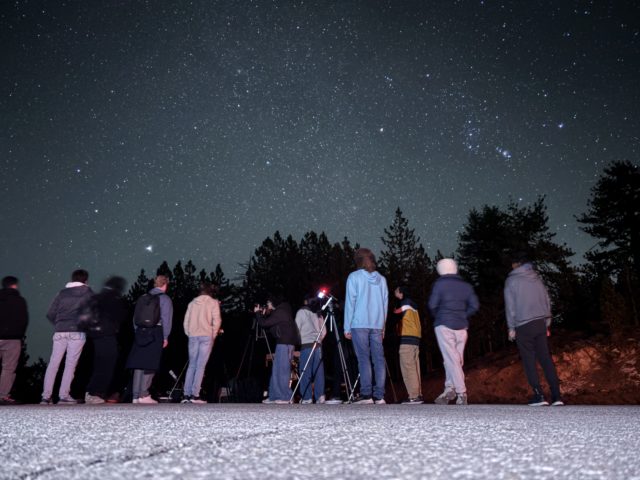
Just two hours away from campus, students can escape Los Angeles’ light pollution and admire the natural beauty of the night sky.
Every fall and spring quarter, the Astronomical Society at UCLA organizes the Star Party, an overnight stargazing trip to Mount Pinos, with about 60 students. This year’s trip is planned for Nov. 6. The Star Party is the club’s biggest event, said Christian Tapper, the club’s co-president and a third-year astrophysics student.
“If there was one thing that people could get out of the Star Party, I would hope that it’s that sense of awe and wonder when they look up at the sky,” Tapper said.
Arjun Gupta, an events officer and telescope operator, said his first Star Party became a core memory for him. At 2 a.m., when attendees were preparing to leave, Tapper pointed to what Gupta had thought were clouds but was actually the Milky Way’s band. Gupta, a third-year molecular, cell and developmental biology student, added that the Milky Way left him awestruck, as he rarely saw stars growing up in New Jersey – where, like LA, city lights obscure much of the night sky.
“In LA, with all the light pollution, if you look up, you can maybe count 10 or 20 stars,” Gupta said. “But for thousands of years, humans have looked up and seen the Milky Way from all across the planet.”
Seeing first-time stargazers’ reactions is rewarding, Tapper said. He added that he hopes students who have lived in cities their whole lives get the chance to observe clear skies through the Star Party.
[Related: Group Persona non grata finds community in welcoming various musicians, sounds]
Outreach coordinator Amberin Rahman said spots on the trip are limited based on the number of available drivers. The club’s officers plan carpooling and coordinate telescope transportation, she added.
Rahman, a third-year astrophysics and neuroscience student, said she made close friends at her first Star Party by bonding over a shared love of astronomy. She joined the club’s board the following quarter and added that she hopes students who attend can both find a community and appreciate the stars.
“Stargazing puts everything back into perspective. We are so small compared to the universe,” she said. “No problem is forever, and it’s very calming.”
Gupta said he joined the club in his first year because of his interest in learning about the universe. He added that he enjoys taking in the beauty of the universe with friends and has recently gotten into astrophotography.
Beyond the Star Party, the Astronomical Society hosts telescope shows Wednesdays that are open to everyone and held on the rooftop of the Math Sciences Building, Tapper said. He added that his role as co-president includes coordinating with the physics and Earth, planetary and space science departments, which own the telescopes the Astronomical Society uses. Gupta also said the club occasionally hosts daytime solar telescope shows outside Royce Hall.
“We invite a bunch of people onto the roof,” Tapper said. “It’s a really great opportunity to get to look through some pretty big and pretty nice telescopes here on campus.”
The club has also hosted Astro Night, an educational event for elementary and middle schoolers featuring speakers and activities, Rahman said. The Astronomical Society’s outreach initiatives also include teaching physics and astronomy to students at Title I schools, she added.
[Related: Hip Hop Congress at UCLA ‘edutains’ students on history, culture behind the music]
Rahman said the club offers a blend of fun meetings – such as an astronomy-themed Heads Up game night – and formal events, including professor talks and resume workshops. She added that the club is open to everyone with an interest in space.
“Even if you don’t know anything about space at all, it’s still so cool to go up to a telescope and look at something that’s hundreds of light years away,” Tapper said.


Comments are closed.