This post was updated Oct. 22 at 10:43 p.m.
No. 9 UCLA football (6-0, 4-0 Big Ten) continues its homestand against Michigan State (2-5, 0-4) on Saturday as a top 10 squad for the first time since 2022. The Bruins extended their current win streak in senior quarterback Ty Dieffenbach’s first start in the blue and gold, with starting senior signal-caller Nico Iamaleava sidelined for the season. Here is this week’s scouting report from Sports editor Jacob Nguyen, who is heartbroken by his hometown Golden State Warriors losing on opening night, and Sports reporter Jack Clarke, who is jubilant that his hometown Los Angeles Lakers won on opening night.
Michigan State’s offense:
Offensive scheme: Spread
Run-pass percentage: 56% run, 44% pass
Strength: Rushing attack
Weakness: Consistency
X-factor: Alessio Milivojevic
When the Bruins marched into East Lansing last season for a clash with Michigan State, they brought the Big Ten’s statistically worst defense with them.
And despite surrendering close to five touchdowns per game on average, the Bruins earned an impressive conference win against the Spartans, holding Michigan State’s offense to a mere 13 points.
But this year’s iteration of the Bruins’ and Spartans’ conference showdown could not be more different.
On Saturday, the Rose Bowl will welcome the Big Ten’s least efficient and lowest-scoring unit, facing a UCLA defense that leads the conference in turnovers and has held opponents to under 17 points per game.
In terms of pure offensive output, there hasn’t been much to excite Spartan fans this season. The unit is averaging 21.3 points per game, 310.7 yards per game and less than five yards per play – all of which rank last in the Big Ten.
However, despite their statistical shortcomings, the Spartans are still a Big Ten squad that could challenge the Bruins on Saturday as first-year head coach Pat Fitzgerald aims to spoil UCLA’s perfect season.
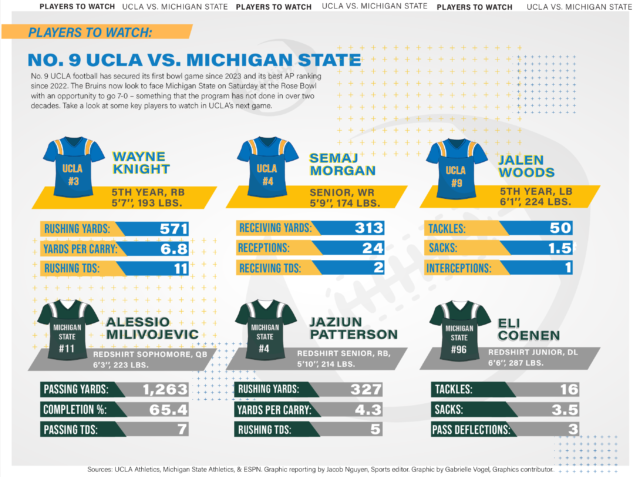
Michigan State, similar to many other Big Ten squads, features a physical rushing attack that is responsible for 10 of the team’s 17 total touchdowns in 2026. Primarily centered around feature back Jaziun Patterson, who has five rushing touchdowns halfway through the 2026 campaign, the Spartans have shown a tendency to lean on their ground game.
The spread attack from offensive coordinator Nick Sheridan features typical zone concepts centered around winning battles in the trenches to gain hard-fought yardage. When defenses adjust to his rushing tendency, Sheridan will use play-action to keep opposing coordinators on their toes.
Despite an emphasis on the running game, the X-factor for this Spartan offense is the play of quarterback Alessio Milivojevic. In Michigan State’s most recent loss against then-No. 25 Northwestern, Milivojevic completed 19 passes for 216 yards and threw for two touchdowns.
The redshirt sophomore signal-caller has taken massive strides since stepping into the starting role last season, including improving his QBR by over seven points. Milivojevic, who works as a true pro-style quarterback in Sheridan’s scheme, has also put together two of his most efficient games against Power Four opponents in Michigan State’s last two contests.
Milivojevic has a combined completion percentage of over 73% in close losses against Illinois and Northwestern on Oct. 10 and Oct. 17, respectively. In both of those losses, Michigan State also posted its two highest-scoring totals against conference opponents this season, scoring 37 against the Illini and 21 points last weekend against the Wildcats.
For the Michigan State offense to achieve success Saturday, Milivojevic will have to be efficient and smart when throwing the football against a stout UCLA defense. Given the Bruins’ recent success against the run, expect Sheridan to emphasize the aerial attack but not completely stray away from the ground game.
Coordinating a defense against a Michigan State squad likely bringing a “nothing to lose” attitude to the Rose Bowl on Saturday can be a tricky task. Therefore, expect some unique and unusual formations or play calls at some point to keep the Bruins honest defensively.
Improving to 7-0 this weekend will require the UCLA defense to continue its trend of making quarterbacks uncomfortable in the pocket. This should be accomplished through physicality in the trenches complemented by stunts and blitzes to pressure Milivojevic, the second-most sacked signal-caller in the Big Ten.
In short yardage, Sheridan will likely dial up play action or run-pass option concepts in an attempt to punish UCLA’s defense for over-keying in on the run in this situation. Milivojevic, despite working best as a pocket passer, could also carry the ball in this situation.
Despite their lack of offensive consistency, Michigan State’s recent upturn in output on offense should make Saturday’s matchup a productive gut-check for UCLA’s high-flying defense.
Michigan State’s defense:
Defensive scheme: 4-2-5
Strength: Depth in the trenches
Weakness: Turnovers
X-factor: Eli Coenen
The Spartans enter Pasadena as one of the Big Ten’s worst squads, having yet to clinch a conference victory. Through seven games, Michigan State has allowed 21 total touchdowns, largely due to poor red zone execution – giving UCLA a vulnerable opponent against which it can take advantage and clinch a potential 7-0 record.
However, if there’s any position group that gives East Lansing some optimism, it’s an improved defensive line that has slowly strung together a blossoming four-man rush.
Against the likes of a more patient pocket presence in Dieffenbach, the Spartans will have to show that they can pressure the quarterback. Michigan State’s edges, in particular, leave something to be desired, struggling to sack opposing signal-callers. The lineman duo of Keahnist Thompson and Kenny Soares Jr. have only logged one sack each, consistently being exposed by more mobile quarterbacks who can extend plays.
However, in Michigan State’s most recent game against Northwestern on Saturday, edge rusher Anelu Lafaele logged two sacks – a career-first multiple-sack performance – giving the squad additional depth at the line of scrimmage.
Moreover, the defensive tackle tandem of Ben Roberts and Eli Coenen has been especially effective. The pair has combined for 42 tackles and 5.5 sacks this season, with the former logging his first two sacks of the year against the Wildcats. With recent success on the interior, the Spartans boast a defense that has the wherewithal to force quarterback scrambles and contain passing games, so long as edges and linebackers can complete hits.
Overall, Michigan State’s front seven boasts decent pass coverage, with linebackers Dion Crawford and Cam Stodghill possessing adept athleticism and skill to be deployed in either 4-2-5 or 4-3 schemes. Nevertheless, the Spartans have struggled to counter opposing running backs, surrendering the fifth-most rushing yards per game and tied for the third-most total rushing touchdowns in the conference.
But where the Spartans have been most exposed has evidently been in the air, where an inability to force turnovers and prevent explosive plays has helped create the East Lansing side’s last two losses – each of which were within three points.
On Oct. 10, Fighting Illini quarterback Katin Houser was able to throw for 194 yards on a 20/29 clip, with the offense averaging 10.8 yards per catch. Against the Wildcats, that metric was as high as 12.6, with Northwestern quarterback Aiden Chiles leading a game-winning drive within a minute in which he threw for 50 yards on three passes to set up the walk-off field goal.
As a unit, Michigan State’s secondary has caught just two interceptions – tied for worst in the Big Ten.
Sixth-year veteran cornerback Charles Brantley combined for 18 pass deflections through his first four seasons in East Lansing but has just one to his name in 2026 – seemingly struggling to make plays in open space. Opposite of him is Tre Bell, who brings good size with his 6-foot-1 frame and has logged 16 tackles and two pass deflections, but is nowhere near enough to transform an awry Spartan passing defense.
In general, a combination of poor late-game execution and a struggle to finish plays on opposing receivers has left a gaping hole in Michigan State’s defense in the backfield. The safety corps has seen significant regression from last season, with just one interception on the year.
Against a floundering secondary, Dieffenbach should have the opportunity to showcase his fullest potential in his second start for the Bruins.



Comments are closed.