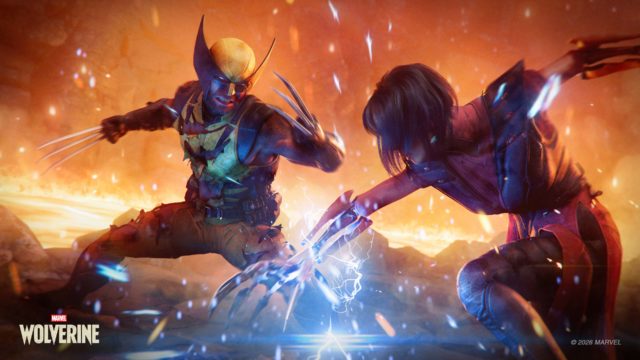


Snikt! The iconic sound of Wolverine’s claws heralds the reluctant hero’s arrival in his first modern solo game – but does it have enough bite to match?
Released Sept. 15, Marvel’s Wolverine is an action-adventure video game developed by Insomniac Games and published by Sony Interactive Entertainment exclusively for the PlayStation 5. The story follows James “Logan” Howlett, a mutant – a human born with superhuman abilities – navigating an increasingly intolerant world. As he reckons with his troubled past, Logan must also stop Bolivar Trask, a nefarious billionaire determined to eradicate mutantkind. Although the premise sets up an intriguing conflict, neither the writing nor the atmosphere can save the game from its villainous shortcomings.
The essence of Wolverine’s character is fear and rejection – emotions that manifest themselves as anger. Logan’s backstory is deliberately ambiguous, but players learn that he was subjected to invasive experiments intended to turn him into the ultimate weapon. Born with the ability to self-heal and extend bone claws from his fists, Logan experienced experimentation that bonded his entire skeleton with adamantium, a fictional, nearly indestructible metal. His stoic stature traditionally conceals a far deeper sadness, but Insomniac puts that pain front and center, leaving little beneath the surface to discover.
Weak writing has been a significant problem in previous Insomniac releases, but it is especially prominent in Marvel’s Wolverine. The unfortunate use of condescending, expository language – often referred to in the gaming community as “Focus, M” dialogue – undermines players’ ability to solve puzzles and interpret events for themselves. To make matters worse, the characters’ use of profanity is incessant, frequently appearing in scenarios where it feels more performative than natural.
The game is best described as an evolved beat ‘em up, an expansion of a traditional arcade scroller. Levels follow a linear structure, alternating between traversal sections and encounters with scattered groups of enemies. Players can either evade enemies through a less-than-fun stealth system or jump into danger claws first. Combat revolves around two attack categories: standard and finisher. Players can leap toward enemies, engage in various combos and unleash up to four special attacks with individual cooldowns. The mechanics are straightforward, but combat develops an engaging rhythm, especially when parrying attacks.
Parry mechanics are a familiar fixture in contemporary gaming, but they seldom fail to please – Marvel’s Wolverine is not an exception. A well-timed parry triggers a satisfying metallic clang through the DualSense controller’s speakers. Combat becomes frustrating when encountering large groups of enemies, where there’s no room to attack without constant parrying. Still, learning when to evade, defend and strike welcomes a layer of strategy and makes for a more robust experience.
Marvel’s Wolverine is Insomniac’s first M-rated superhero outing. But regrettably, the game delivers all of the blood and none of the glory. One might assume that the M rating would allow for more mature storytelling, but beyond its gratuitous violence, the game feels like a child’s idea of what an adult story should look like. Granted, this is coming from the studio behind the family-oriented Ratchet & Clank and Spyro series, but players should be allowed to expect some degree of narrative sophistication from the studio – or, at the very least, a compelling protagonist that doesn’t feel so one-note.
If not for Liam McIntyre’s performance as Logan, the entire story would fall flat. Even Troy Baker, known for his award-winning roles in The Last of Us and countless other games, cannot make Dr. Nathaniel Essex feel sufficiently sinister beyond the character’s unidimensional writing. Most of the characters lack a basic sense of humanity due to the compounded poor direction of their vocal performances. Notably, Sabretooth barks all of his lines, mimicking the sound of a poorly dubbed anime, dampening the chance of making dramatic confrontations feel more than comical.
The story fares no better. Tasked by Dr. Nathaniel Essex, Logan and the rest of Team X must stop Bolivar Trask from building a fleet of Sentinels – machines that can identify and eliminate mutants worldwide. Insomniac Games is treading old ground with the Roxxon plotline from the original Marvel’s Spider-Man game. As the plot unfolds, however, the players realize that Essex has been manipulating Logan all along. His ultimate plan is to eliminate all non-mutants worldwide, a goal that mirrors the inverse of Trask’s. But Essex’s plan is entirely unclear. Why would he need to kill all non-mutants to absorb the powers of the remaining mutants? The power-high trope is played out and lazy.
The sequence in Japan, arguably the coolest part of the game, offers a welcome reprieve from narrative banality. The appeal of this section comes from infiltrating an underground base and later exploring a small village, rather than wandering the area’s lifeless streets. The scene feels similar to films like “Enter the Dragon” or “Indiana Jones and the Temple of Doom.” Even Logan’s skin-tight yellow jumpsuit is reminiscent of Bruce Lee’s in “Game of Death.”
While composed of memorable leitmotifs and scattered highlights, the music comes off about as monotone as the game’s protagonist. Essex’s fully realized theme is worth its sonic build-up, but much of the score fails to match the emotion of the scene it accompanies. It either drones during action sequences – instead of heightening the tension of combat – or undercuts the gravitas of otherwise potent scenes. The result is far from the manicured soundtracks of Insomniac’s Spider-Man games, whose sweeping orchestral flourishes complement each story beat.
The third act introduces a meaningful thematic twist, but there’s not enough of a personal narrative to make it impactful. The persecution of an underrepresented group by a government-backed corporate entity and their systematic detention reads as an allegory for real-world immigration enforcement. Yet, Logan never meaningfully interacts with that side of the narrative. His personal arc is mainly about understanding who he was in a past life, recognizing his flaws and accepting himself – including the possibility that he can be loved despite them.
These themes are not incompatible, but the game struggles to bring them together. Aside from a few interactions with Jean and Callisto’s crew, Logan never really engages meaningfully with the mutant persecution plot. With many competing ideas, the game fails to give any story thread the attention it deserves to resonate with players.
While it has its satisfying moments, Marvel’s Wolverine is undermined by shallow writing, unconfident game design and narrative themes that ultimately feel disjointed.
So, is Wolverine worth the dive? Think again, bub.


Comments are closed.