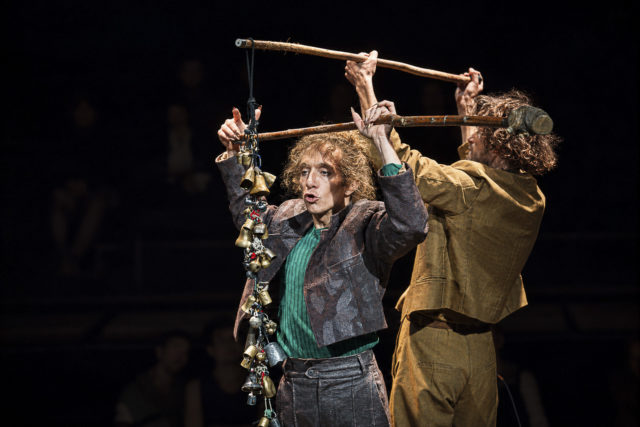
Before they could find their rhythm, a dancer had to coax the beatboxer to his feet.
Beatboxer Aymeric Hainaux and dancer-choreographer François Chaignaud brought “Mirlitons,” a live duet of beatboxing and dance, to the UCLA Nimoy Theater on Friday and Saturday. Hainaux built rhythms through vocal percussion, while Chaignaud answered with percussive footwork and choreography. The duet gave neither artist sole custody of the rhythm, with both contributing to its sound and style in a continuous exchange – movement made music, and music put bodies in motion.
“We didn’t want to have a beatboxer who makes music for a dancer,” Hainaux said. “We wanted to move our bodies and make sounds all together with our practice and what we are.”
Both artists draw on disciplines beyond their primary practice. Chaignaud, a graduate of Paris’ National Superior Conservatory for Music and Dance, creates work that intertwines dance, singing and history. Hainaux began his artistic career with comics and painting before turning to beatboxing. His practice emphasizes silence and movement with sounds performed live rather than stacked through a loop pedal. In 2005, he began an eight-year hitchhiking journey and tour, later forming music duo Cantenac Dagar and expanding into poetry. Since 2011, he has also run Isola Records, a label that publishes books and releases music.
[Related: Yvette Janine Jackson’s radio opera ‘Harvest’ sows seeds of sound at UCLA Nimoy Theater]
At the Nimoy, roughly 50 spectators gathered around a black platform set among cream-colored cushions and chairs. Members also sat on the stage and in the theater’s elevated front row. The performance began with the house lights still on – Hainaux lay on a red cloth as Chaignaud stretched his leg and pulled him in a circle around the platform before helping him stand. Later, with Chaignaud out of the performance area, a spotlight isolated Hainaux. Working with and without a wired microphone, the beatboxer used his breathing to shape the sound.
Audience member Natalia Lagover said the draw was the chance to encounter something unfamiliar. Originally from Ukraine, Lagover added that she missed attending theater back home and had been seeking out original performances in Los Angeles. A promotional video on Facebook caught her attention with its rhythm and sound, she said, prompting her curiosity about how the performers at the event would communicate through movement.
“I’m very interested (to see) if I will understand what they want to say to people who will watch them,” Lagover said.
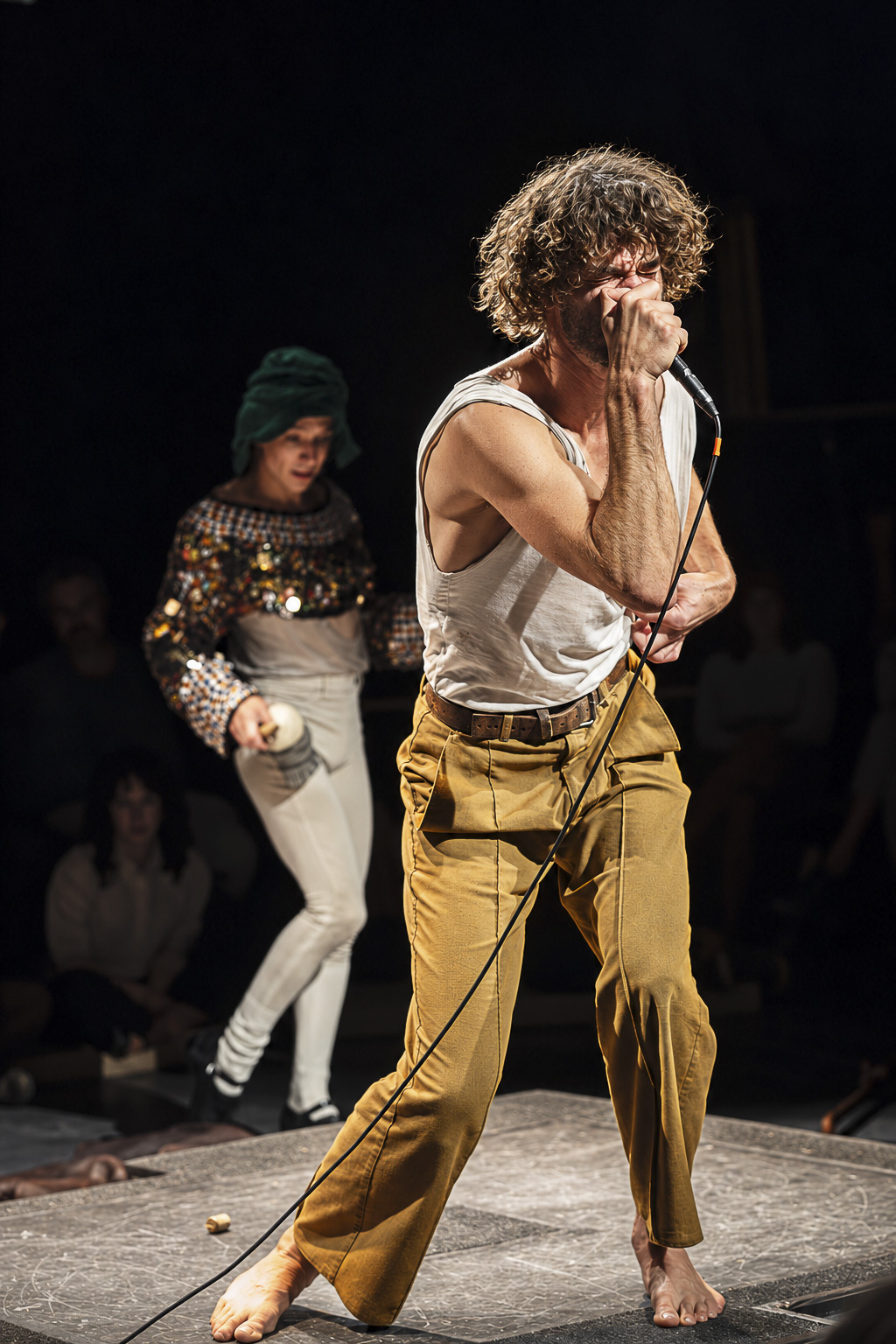
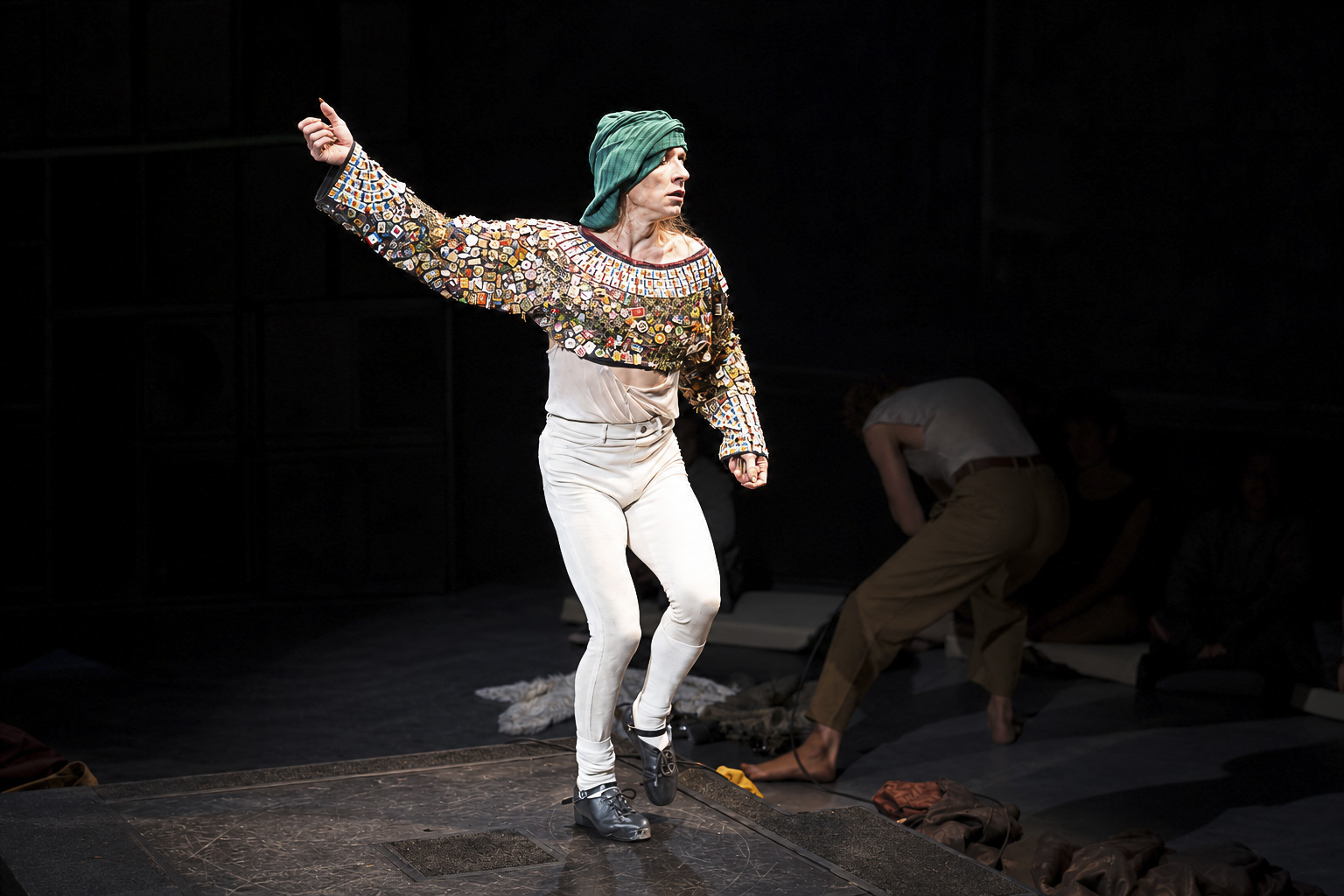
“Mirlitons” played out in distinct passages rather than a steady crescendo. Loud exchanges of beatboxing, percussive footwork and thunderous striking against the floor gave way to slower movements and subtler sounds. The performers fluctuated between force and restraint. After Hainaux’s opening solo, a costume change added another layer of the percussion – Chaignaud’s metal, charm-covered jacket jingled as he moved. Both performers wielded tall, branch-like sticks, with a string of brassy bells attached to Hainaux’s, which added another resonant sonic layer to the performance.
“Even though it (the performance) looks like it’s free – actually – it’s super well written, and we are following a frame,” Hainaux said.
He added that the performers spent three years developing the piece around a seven-beat rhythm, rather than four-count or eight-count structures. The unusual rhythm offered both performers a collective challenge instead of allowing either to over-rely on their respective strengths.
That framework was not always apparent. Through surges in sound, costume changes and incursions into the cushions, the choreography took on the unpredictability of a conversation, with each exchange seeming to set the next in motion.
Wearing tap shoes, Chaignaud sometimes rivaled the volume of the sticks, using his feet as instruments. His footwork was not confined to standing upright. At one point, balancing on his head between seated audience members, he spread his legs and tapped his feet to Hainaux’s beat. With Chaignaud’s footwork, the exchange made their collaboration audible, as both performers contributed a rhythm of his own, which the other answered. Variations in lighting further shifted the atmosphere, moving from singular spotlights to a brief wash of cool violet near the end.
“We also wanted to get focused on something super raw. No effect, no Waymo, no AI – only very raw music with raw bodies,” Hainaux said.
The audience was hardly offstage. Socks landed among seats, the microphone tapped attendees’ heads and the space between seated couples became room to dance. Sitting in the second row of cushions was Manuela Ammendola, who said her close proximity made the experience feel unpredictable.
“You’re basically integrated in the performance,” she said.
Ammendola said the proximity also made her hesitant to get too involved. She added that she worried about being caught by the performers’ sweat or a moving stick and felt particularly concerned for those in the first row as the action moved between seated spectators. Still, Ammendola said she interpreted the performers’ physical exchanges as expressions of interdependence, with one asking the other to join in.
Yet the duet’s gentler exchanges left a different impression. More than halfway through the duel, Hainaux and Chaignaud sat on opposite sides of the platform, their backs turned toward each other, singing together beneath a dim spotlight. Their voices that contributed to the performance’s percussive intensity became a source of warmth.
Intensity was only one part of the pair’s relationship. The singing complicated the idea of a duel – the same two performers who had traded emphatic rhythms now harmonized.
“We found out that the piece was very messy and intense,” Hainaux said. “It was very important for us to have fragments of silence – of minimal sound, very quiet sound.”
[Related: Concert Review: Weezer leans into classics to close North American leg of ‘The Gathering’ tour]
Ammendola added that she saw an interdependence in the way performers carried each other. She said a passage performed behind a towel resembled a distant sports broadcast, adding another dimension to the soundscape.
Their partnership began long before “Mirlitons.” Hainaux said Chaignaud approached him after a solo performance in Paris in 2010. After hitchhiking and performing across the world for around a decade, he said he wanted to return to movement-centered work. He reached out to Chaignaud and discovered the interest was mutual.
For “Mirlitons,” the pair wanted to strip back the work to its physical essentials.
“I have bands,” Hainaux said. “I make music. I make people dance.”



Comments are closed.