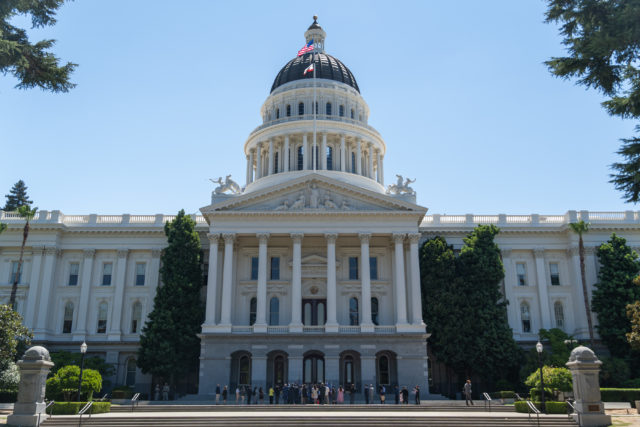
California’s next governor will inherit a public higher education system facing rising education costs, increased student living expenses and federal funding uncertainties.
With Gov. Gavin Newsom leaving office after eight years, the next governor will establish new budget priorities for California’s public colleges and universities. UCLA experts said the extent to which the transition will affect UC funding could depend on both California’s fiscal condition and the incoming administration’s priorities.
California voters will choose between Democrat Xavier Becerra and Republican Steve Hilton in the Nov. 3 election. Becerra and Hilton advanced from California’s June 2 primary and are competing to succeed Newsom, who is ineligible for a third term.
Jim Newton, a lecturer of public policy at UCLA, said the next governor will influence tuition decisions through their role on the UC Board of Regents. The governor serves as an ex officio member of the board.
“You almost can’t list the number of ways in which governors can affect life of campuses in the state,” Newton said.
Ozan Jaquette, an associate professor of education, said Newsom has been relatively generous with granting the UC funding in comparison to previous governors. A change in governor could therefore be one of the most consequential factors affecting the UC budget, Jaquette added.
Higher education is not listed as a priority on Becerra’s campaign website. However, Becerra said in prepared remarks published on his campaign website June 2 that he would invest in California schools and “fortify” the state’s higher education system to help students become leaders.
Becerra did not outline specific proposals in the statement that addressed tuition, financial aid or funding for the UC and California State University systems.
Becerra also proposed creating artificial intelligence literacy programs through public schools, libraries and California Community Colleges, as well as developing more workforce preparation programs, on his campaign website.
Hilton, on the other hand, has centered his higher education platform on affordability and accountability. On his campaign website, Hilton has proposed freezing in-state tuition at public colleges, expanding three-year degree options and simplifying the community college transfer process.
Hilton also wants to prioritize California residents in admissions and increase financial oversight across universities through audits and program reviews.
The UC’s Tuition Stability plan freezes tuition costs for students at the time of entrance for up to six years. Under the plan – which was renewed by the UC Board of Regents in November – 40% of new undergraduate tuition revenue is set aside for financial aid.
[Related: UC Regents amend, renew progressive tuition increases for new students]
The higher education plan on Hilton’s campaign website also calls for reviewing how student housing is used and prioritizing it for students with the greatest need. It proposes a “Kindergarten-to-College Pipeline Strategy” aimed at preparing students for college and reducing the need for remedial courses, which teach foundational skills students need before taking college-level classes.
California’s reliance on personal income tax revenue makes the state budget particularly responsive to changes in the economy and stock market, said Daniel Mitchell, a professor emeritus at the Luskin School of Public Affairs and Anderson School of Management. Those economic conditions could heavily influence UC funding regardless of who becomes governor, he added.
“There’s continuity in the politics; it’s just a question of whether there’s continuity in the economics,” Mitchell said.
Mitchell said he does not expect higher education policy to immediately change when the next governor enters office. Because the state budget for the 2027-28 fiscal year will have been mostly developed under the Newsom-era department of finance, there will be a more gradual move to the new administration’s priorities, he added.
“It’s a gentle transition rather than some complete change in policy that’s going to occur,” Mitchell said.
However, the governor can still significantly influence the amount of state funding provided to the UC and where it will go, said Valerie Lundy-Wagner, an associate director of the Public Policy Institute of California Higher Education Center.
Newsom announced a five-year compact with the University in 2022, which promised an increase in state funding to the UC in exchange for increasing in-state enrollment and graduation rates.
The UC has greater constitutional autonomy than California’s other public higher education systems, and the Regents generally have authority over the University’s operations, Jaquette said. However, the governor has influence over state appropriations, which can affect tuition costs, he added.
Jaquette said the next governor’s budget proposals will help shape whether state support keeps pace with the cost of providing a high-quality UC education. If that funding falls short, the University may need to raise tuition or reduce educational quality, he added.
“There’s a reality of providing high quality education at scale costs money,” Jaquette said.
Affordability will also be one of the largest challenges confronting the next gubernatorial administration amid rising costs of living, Lundy-Wagner said. When budgets tighten, programs that receive temporary or designated funding can be particularly susceptible to reductions, she added.
The next governor can address affordability issues by making it easier for eligible college students to receive government benefits, Lundy-Wagner said.
Along with state budget pressures, the next governor will inherit federal funding uncertainties.
The Trump administration suspended $584 million in UCLA’s federal research grants in 2025, alleging that the university allowed antisemitism, “men to participate in women’s sports” and affirmative action. Chancellor Julio Frenk denied the allegations in a January Q&A with the Daily Bruin.
A federal judge ordered the administration to restore most of the grants in August and September 2025. The same judge separately ruled in November that the federal government could not freeze or threaten to freeze any more of the UC’s federal research grants.
[Related: One year after $584 million federal funding freeze, UCLA research still recovering]
“Research funding or educational funding generally, those depend much more on Washington, and so they are in danger for sure,” Newton said.
Governors can influence UC policy over time by appointing members to the Board of Regents, who have the authority to set tuition rates and manage the University’s funding distributions, he added.
[Related: UC has increased reliance on tuition revenue due to funding changes, report finds]
At the same time, Mitchell and Jaquette noted that the choice of governor will not be the sole factor affecting the UC budget. The legislature, the Regents and economic conditions all influence available resources, and Newton said uncertainty remains surrounding federal research funding.
Newton said students evaluating the next governor’s education priorities should consider how the governor’s support for investment in universities could shape California’s economy and the state’s intellectual life and culture over time, beyond the immediate effect on tuition costs.
“It’s not just affecting how much you have to pay this quarter or this semester: it’s affecting the quality of the place that you, I would hope, want to grow up in and raise a family and live in,” Newton said.


Comments are closed.