No. 7 UCLA football (7-0, 5-0 Big Ten) takes a break from conference competition when it takes on Nevada (3-4, 2-2 Mountain West) Saturday afternoon at the Rose Bowl. The Halloween affair will be the Bruins’ third consecutive home game and features the blue and gold ranked the highest it has been since 2015. Here is this week’s scouting report from Sports editor Jacob Nguyen, who is ready for some Halloween festivities during and after the game.
Nevada’s offense:
Offensive scheme: Spread
Run-pass percentage: 57% run, 43% pass
Strength: Run game
Weakness: Quarterback consistency
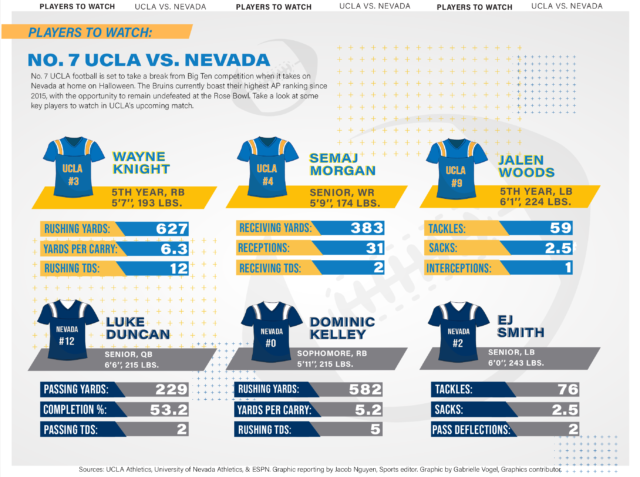
X-factor: Luke Duncan
Facing the Wolf Pack on Halloween, the Bruins will be welcoming a familiar face – and it isn’t just the hordes of fans likely to be donning famous monster masks.
Former UCLA-turned-Nevada quarterback Luke Duncan makes his return to Westwood, where he spent three seasons and appeared in just two games in 2025. The former Bruin has started just two games and played in three matches this year, although he started in the Wolf Pack’s most recent outing in a 28-13 victory over San Jose State.
With injuries to both Carter Jones and AJ Bianco, Nevada will likely roll with Duncan once more – giving the Orinda, California, local his first opportunity to suit up at the Rose Bowl on the opposite side of the field.
In his last performance, Duncan completed 18 of 29 passes for a total of 178 yards and two touchdowns, en route to the home victory in which he connected with seven different teammates. Duncan displayed much-improved comfort under center and a more capable arm after his initial start on Sept. 12 against Montana State, where he threw for just 51 yards and two interceptions – eventually being subbed out of the match for Bianco.
Duncan’s ability to convert on third downs was evident against the Spartans, where he was able to dot up fellow receivers in man coverage and consistently manage the offense. However, the former Bruin’s limitations with overall processing speed and mobility, especially under pressure, are likely a key area for UCLA’s pass rush to exploit. How Nevada’s offensive line can hold up against a physically imposing UCLA front seven should dictate how efficient Duncan can get the Wolf Pack’s spread offense going in the air.
Nevada’s inconsistency with its signal-callers – both with personnel and production – has ultimately undermined its ability to get receivers involved. The Wolf Pack has just one 200-plus yard receiver, with Gary Givens III collecting 305 on 19 receptions on the year.
Rounding out the top three of Nevada’s wide receivers are Damien Morgan – an Idaho State transfer – and Marshaun Brown, who brings a large 6-foot-4 frame and deep-threat ability. Brown is the Wolf Pack’s only multi-touchdown receiver with two, most recently leading the squad with 52 receiving yards on five catches against the Spartans.
While Nevada has already cycled through three distinct quarterbacks this season, one aspect has remained constant: the running game.
Spearheaded by Dominic Kelley, the sophomore running back has totaled 582 rushing yards and five rushing touchdowns on 111 carries. Kelley’s power and ability to accelerate allow him to break tackles and make him a difficult opponent to bring down. Paired with fellow running back Herschel Turner, Nevada boasts a productive run game in its first year in the Mountain West, with the duo combining for 1,062 yards on the ground and nine rushing touchdowns.
Nevertheless, with UCLA entering Halloween as the heavy favorites, Saturday afternoon might be an opportunity for the Bruins’ defense to go trick-or-treating.
Nevada’s defense:
Defensive scheme: 4-2-5
Strength: Front seven
Weakness: Turnovers
X-factor: EJ Smith
Nevada’s defense features one of the country’s best tacklers in linebacker EJ Smith, who is tied for fourth in the country with 76 tackles as well as two pass deflections. After spending two seasons at Cerritos College, the AP Midseason All-American Second Team selection is the only Mountain West name on the list, pairing high-volume production with elite pass coverage and play recognition, helping lead the conference’s second-best passing defense in terms of both total yards and yards per play.
Smith’s versatility in the box has also rewarded him with 2.5 sacks, combining with defensive edge Dylan LaBarbera, who has logged 10.5 total sacks in his last two seasons, including four in 2026. Opposite of LaBarbera is fellow defensive edge Myles Williams, who has contributed another 2.5 sacks this season.
As a unit, Nevada’s front seven has been strong in the pass rush, most recently forcing San Jose State into six consecutive three-and-outs to start the game and just one third-down conversion on 14 attempts. The Wolf Pack’s ability to routinely get to the quarterback and put opposing signal-callers under duress has paid dividends, as Nevada has allowed the country’s sixth-fewest passing yards per game with just 153.9.
Nevada’s ability to mix up coverages in the backfield allows it to confuse opposing quarterbacks and disrupt otherwise clean throws, which has been particularly effective on third-down defense, where the Wolf Pack can more heavily blitz on one side or the other.
Although it possesses one of the conference’s best passing defenses, Nevada simply struggles to convert stops into turnovers. Despite having totaled 25 pass deflections as a group all year – with defensive backs Bryson Snelling and Larry Turner-Gooden leading the way with five apiece – the Wolf Pack has caught just one interception through 2026, seemingly struggling to complete plays despite getting hands on balls.
Additionally, despite Smith’s growth as a physical run stopper, the unit as a whole has been a rather middling defense against heavier ground concepts, allowing 166.4 rushing yards per game, boding well for one of the country’s best running back rooms in Westwood.
If Nevada is unable to turn tight coverage into consistent stops, it’s hard to imagine an undefeated UCLA squad slowing down at home over the holiday weekend.



Comments are closed.