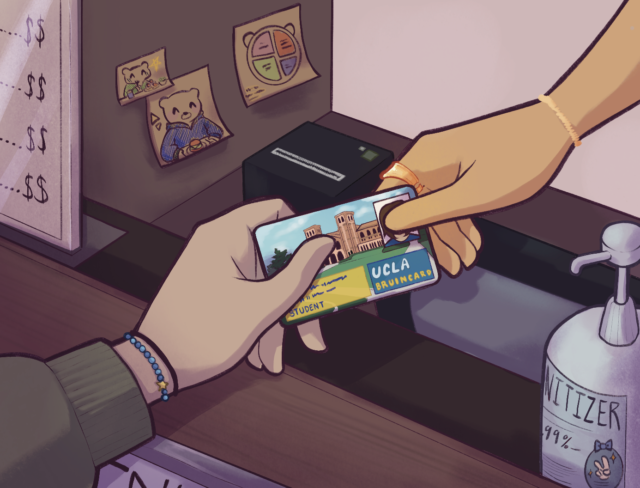
UCLA is revered for its superb dining halls and on-campus restaurants. But people often ignore the price tag that comes with each meal plan.
Meal plan devaluations, coupled with the rising cost of food, are increasingly restricting students’ access to on-campus dining.
UCLA values a meal swipe at $10. That means for each swipe, students have $10 to spend at ASUCLA restaurants. Yet when you break down UCLA’s meal plans, which students must have to live on the Hill, the total cost comes out to more than $10 for a single swipe – for example, the 11 Premier plan charges over $16.
In addition to paying that excess, students face strict policies for on-campus use. UCLA Housing announced in July 2025 that students could no longer swipe at non-ASUCLA-operated, third-party restaurants such as Panda Express and Veggie Grill. Furthermore, students can only swipe at those restaurants between 11 a.m. and 3:59 p.m. on weekdays.
UCLA should increase swipe values and adjust its time-restrictive policies to accommodate for rising menu prices and students’ tight schedules.
The five-hour open window for ASUCLA restaurants is unrealistic. Most classes are scheduled from 9:00 a.m. to 3:00 p.m., meaning students with afternoon classes have less time to get food. After 3:59 p.m., students either have to wait for restaurants on the Hill to open at 5 p.m. – only Bruin Café is open at 4 p.m. – or dip into other funds to eat on campus.
“I do remember having a lot of classes back to back, so by the time I got out, I can’t use my swipes anymore,” said Jessica Kennedy, a third-year business economics student and 19 Premier meal plan user.
Many items at on-campus restaurants have also surpassed $10, forcing students to either avoid certain menus or supplement their swipe with their own money.
“Price increases across ASUCLA Restaurants have been necessary due to continued inflation and rising operating costs, including higher labor costs, transportation and fuel expenses, the increasing cost of food and supplies, and significantly higher utility costs,” said Pouria Abbassi, the ASUCLA executive director, in an emailed statement.
However, students are experiencing financial struggles, too. They now have less access to meals at UCLA with their meal plans.
Kennedy said that for menu items that are a little over $10, she uses her own money. The additional charges add up, she added – students without other sources of income may be inclined to only purchase items within the $10 swipe limit.
Xcaret Calderon, a second-year Chicana, Chicano and Central American studies student and an ASUCLA restaurant employee, said she’s seen a decline in student patronage following new policies.
Kennedy and Calderon are voicing the reality students are facing with the current meal swipe system: Their needs are not being met.
Some argue that the pricing of the plan is justified, given that dining halls offer students access to high-quality food with one swipe on the Hill. Without a swipe, the price of dining hall entry for on-campus students is between $19 and $24.
However, on-campus dining is convenient for most students and is a fundamental part of campus culture. ASUCLA serves about 22,000 people a day, many being meal plan users. Swipes at ASUCLA restaurants should be given the same value and consideration as dining halls.
To live up to its No. 1 college food ranking, UCLA must make its meal plans more accommodating.



Comments are closed.