This post was updated Nov. 20 at 10:30 p.m.
The UC Board of Regents presented its proposed 2027-28 state budget Wednesday, requesting an increase of $335.5 million in ongoing state support.
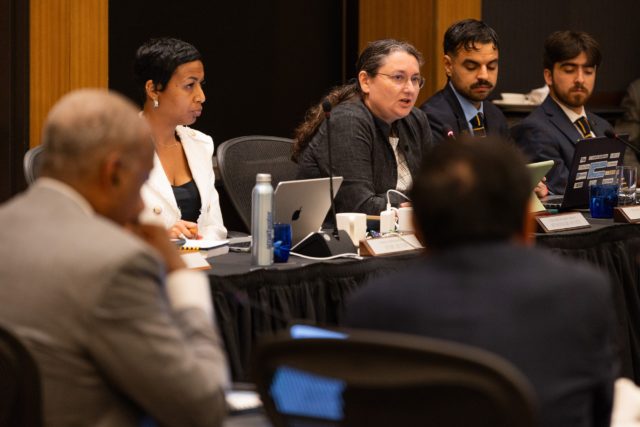
The regents’ Finance and Capital Strategies Committee reviewed the proposal, which requests funding from the upcoming state budget – the first one to be reviewed by incoming Gov. Xavier Becerra’s administration – and the University’s investments, finances and retirement obligations at its bimonthly meeting at UC San Francisco’s Mission Bay Conference Center.
The regents’ proposed 2027-28 budget requests $401.5 million in state funding to restore deferred support from the previous fiscal year and $1.5 billion in one-time funding for capital projects, as stated in the report.
The proposed budget includes a request for $157 million in permanent funding and $43 million in one-time funding to establish the UC-wide California AI Institute, said Nathan Brostrom, the UC’s executive vice president and chief financial officer, at the meeting. The institute would provide independent safety tests of artificial intelligence, expand public AI computing access across California and support AI workforce development.
Note: Figures represent proposed ongoing State General Fund increases, excluding one-time requests.
Source: University of California, 2027–28 Budget Plan. Graphic reporting by Bianca Peralta, Data editor.
“It would enable UC and the state to form partnerships both with the state and the industry in this critical sector,” Brostrom said at the meeting.
The budget is the first outside the University’s five-year compact with the state. The previous compact, spearheaded by Gov. Gavin Newsom, promised the UC an annual 5% increase for five years in exchange for improving graduation rates and enrolling more California residents.
The committee also discussed a proposal to replace the UCLA West Valley Medical Center with a new facility instead of renovating and retrofitting it.
When UCLA Health acquired the hospital in March 2024, the estimated cost to retrofit the building for earthquake safety was $1.1 billion over nine years, said Peter Hendrickson, associate vice chancellor of design and construction for UCLA Capital Programs, at the meeting. He added that the cost to retrofit was underestimated, and the project would actually cost $2.3 billion over 19 years to complete.
The regents raised concerns about UCLA Health’s acquisition and its due diligence process.
“I’m getting more and more skeptical of any future transaction that I should take the materials at their word in terms of what your intention is,” Regent Michael Cohen said at the meeting.
The revised plan calls for a new, approximately 585,000 gross square foot hospital with 260 to 300 inpatient rooms and an emergency department, according to the discussion item. The existing hospital would remain open during construction before being demolished once the new facility is operational.
The change will help address an ongoing overcapacity issue across UCLA Health campuses, UCLA Health President Johnese Spisso said at the meeting.
“Having 10 million people to serve, and being one of the few tertiary and quaternary care providers, we are still feeling a constant sense of catch-up,” Spisso said.
The Regents approved $120 million in preliminary planning funds for the project sourced from hospital reserves. UCLA Health expects to return for further approvals in 2028, with the replacement hospital expected to be completed in 2034 – four years after the seismic deadline set by the state, according to the item.
Under California’s hospital seismic safety requirements, general acute care hospitals must ensure their buildings meet the required structural and nonstructural seismic standards by 2030.
The committee is considering a $327.9 million budget for improvements to the UCLA Research Park’s east building, said Pete Angelis, UCLA’s former associate vice chancellor for housing & hospitality, at the meeting. The research park will be a 700,000-square-foot hub for biomedical research. The university would retrofit approximately 530,000 gross square feet of the east building of the research park into a multi-tenant scientific research facility, which will host biomedical research and quantum physics laboratories, according to the report.
“We will move closer to fulfilling the potential of this extraordinary initiative, so that important research work can begin,” Chancellor Julio Frenk said at the meeting.
The two projects are part of the University’s broader proposed 2026-32 $29.9 billion capital financial plan. The plan includes investments in housing, research facilities, seismic safety and aging infrastructure – representing a $2.9 billion increase from the previous year’s proposal, as stated in the item.
UCLA could receive approximately $2.8 billion of the proposed campus investments, which will support housing, seismic safety projects, research, infrastructure repairs, and enrollment and student services, as outlined in the item.
Operating expenses exceeded operating revenue by $433 million during the 2025-26 fiscal year, the committee said. Higher compensation and benefits costs – alongside decreased federal research funding – contributed to deficits at most University campuses, as outlined in the report.
The committee also said the UC Retirement Plan reported $131 billion in market-value assets as of June 30, up from $110.7 billion the previous year, as stated in the item. These assets represent the UC’s investments to help pay retirement benefits to its employees.
The University projects that it will contribute approximately $6 billion to the retirement plan in 2027-28 to help fund those benefits.
Separately, the University’s retiree health benefit liability – which is the money the UC expects to spend to provide health care benefits to retired employees – increased to $23 billion as of July 2026, up from $19.5 billion the previous year. UC cash costs for retiree healthcare are projected to total $544 million in the upcoming fiscal year – a 15% increase from the previous year, as outlined in the report.
“The University must exercise cautious, prudent financial management amid rising personnel costs and ongoing financial uncertainties,” said Barbara Cevallos, the UC’s associate vice president and systemwide controller, at the meeting.




Comments are closed.