

This post was updated July 26 at 5:41 p.m.
A man. A thought. A war. In a time of apparent magic, “The Odyssey” proves the ancient tale is still worth retelling.
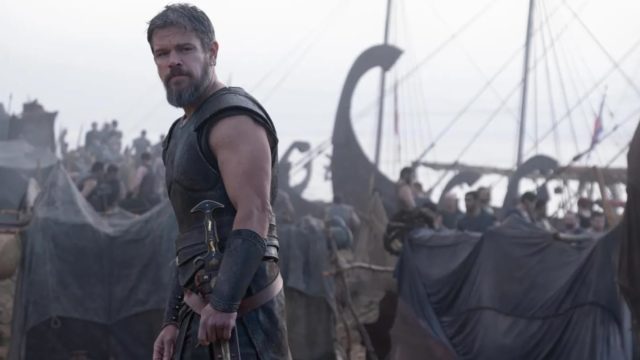
Christopher Nolan’s 2026 action-adventure blockbuster adapts the millennia-old Homeric poem like never before. The epic follows Odysseus, the hero of the Trojan War, on a decade-long journey back to his home in Ithaca, as he faces mythical creatures, magic wielders and warriors of yore. While awaiting his return, his wife and son must ward off sycophantic suitors and power-hungry adversaries. Two-time Academy Award winner Nolan assembles a star-studded ensemble cast, featuring Matt Damon as Odysseus, Anne Hathaway as Odysseus’ loyal wife Penelope and Tom Holland as their promising son Telemachus. The film is yet another monumental entry in the director’s filmography.
Following “The Dark Knight,” Nolan redefined his signature style through IMAX spectacle and sentimental storytelling. He alternates between stories about the past and future, from historical dramas and the grounded realism of his Batman films to the speculative dread of “Tenet” and “Interstellar.” “The Odyssey” is the first time he’s combined his historical and futuristic impulses, using the past to tell a story of the future.
[Related: Film review: ‘Supergirl’ soars with casting, visuals but loses sight of its heroine]
The writer-director’s adaptation is a daring, emotional response, not to any one particular event but to the death of courtesy and humanity altogether. He shifts the focus of the story toward the pride and barbarism of the Trojan War and Odysseus’ guilt over his role in its destructive legacy. Zeus’ law, which dictates that mortals should treat others with hospitality, is central to the film. By hiding Greek soldiers inside the wooden horse disguised as a gift, Odysseus desecrates Zeus’ law, and his men’s actions continue that pattern of sacrilege throughout the voyage. Every isle they reach, every situation they encounter costs them more men as they act out of hubris and suffer the consequences. Even Circe, who is traditionally depicted as a villainous sorceress, is far more sympathetic in this iteration, petrified by what Odysseus’ men are capable of.
Nolan demonstrates his ability to create blockbusters that still reflect deeply personal stories in one of the film’s most inspired scenes, when Odysseus recounts the siren’s song. He describes it as everything one would want in life yet everything we cannot have, reminding viewers to think of their broken promises and lives unlived. The theme of one man’s regret over a single, fateful decision is directly in conversation with Nolan’s previous work, “Oppenheimer,” while also reiterating a longing to return to one’s family, as in “Interstellar.”
This emotional resonance would not be possible without the film’s performances. Hathaway’s lament is palpable through the screen, not just for her long-lost lover but also in her repressed disappointment in Telemachus. Her portrayal is both understated and compelling. Zendaya, who plays Athena, has only a few moments of screen time yet haunts the narrative all the same. Her chilling scene at the Battle of Troy, elevated by her evocative performance, is arguably what ties the film together. The same cannot be said for her offscreen partner, Holland, whose portrayal has its merits yet feels out of place – a redux of Peter Parker in a world of antiquity.
[Related: Film review: ‘The Mandalorian and Grogu’ chokes on its aspirations with lack of novelty]
Regarding its presentation, the scale and impact that come with IMAX make a significant difference. Nolan and Hoyte van Hoytema, the film’s cinematographer, have a distinctive approach to cinematography. In one interview, Nolan discussed how he does not compose his shots to fit a traditional pictorial frame, which blocks subjects in relation to one another. Instead, he thinks about how actors and subjects are positioned in relation to the audience. Shots are meant to invoke a sense of magnitude – thus, the IMAX aspect ratio is not shown on ordinary screens. The additional information in large-format screenings is designed to be peripheral. The duo employs an incredibly emotionally driven shooting technique, one that’s rarely been verbalized before in cinema and benefits from a premium presentation.
Jennifer Lame, the film’s editor, elevates those shots through deliberate structural choices. Though the movie is told in a non-linear fashion, most scenes are edited traditionally and with attention to emotion. However, she periodically intercuts them with shots of character reactions and flashbacks, like in Menelaus’ palace when Helen tells Telemachus about Agamemnon’s betrayal. While it’s impressive that the film comes in under three hours, there’s rarely any time for the audience to rest. Coupled with the story’s unorthodox structure, the relentless pace at times makes it difficult to connect with the film.
Even so, the film’s technical craftsmanship remains consistently remarkable, just like its score. Much like the film’s avant-garde production design, Ludwig Göransson’s monumental score combines the bombastic sounds of heart-pounding drums and industrial racket with stripped-down accents of ancient Greek instruments, like the lyre and aulos. It sustains the Swedish composer’s reputation for reaching the sonic root of any project he undertakes. Ultimately, the film’s technical prowess results in a profoundly human story.
If Helen of Troy was the face that launched a thousand ships, Nolan’s Odyssey is one that seeks to bring them home.





Comments are closed.